
Better Halves
A short story from the Uncanny Valley

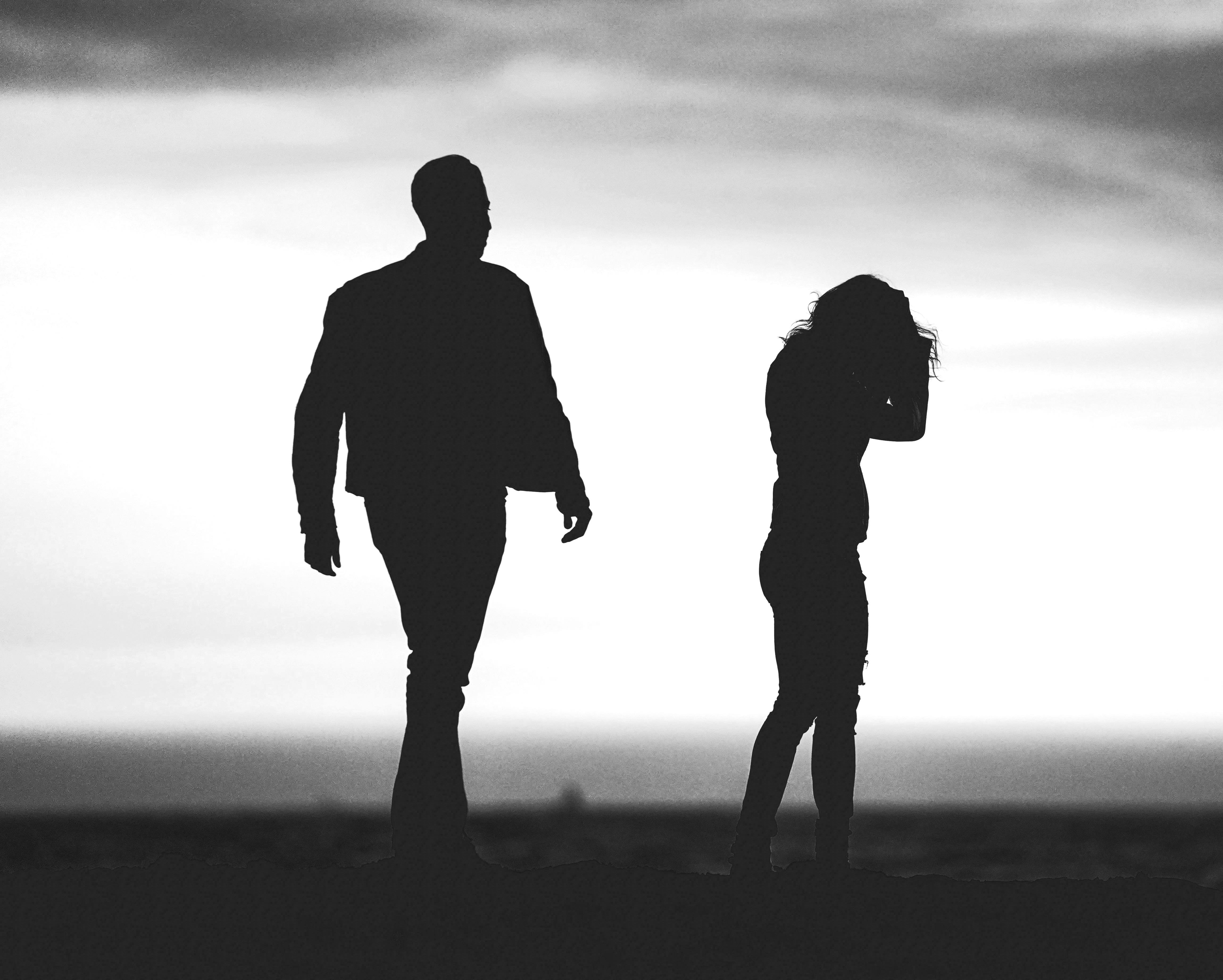
The silence was the worst part. After the shouting, after the accusations found their mark and the slammed door rattled cheap photo frames, this remained. A thick, ringing void where words had been. The air tasted of metal, the sour residue of their shared shame.
On the pale grey wall by the kitchen door, a splash of red wine was slowly bleeding downwards, a single, weeping wound. Neither of them had thrown the glass. It had just been knocked, a casualty of a wild, angry gesture. An accident. Like them.
Ben was on his knees, punishing the skirting board with a damp cloth. His furious, circular motion did nothing but smear the stain, grinding it deeper into the paintwork. It was something to do with his hands, a way to exhaust the tremor that started in his gut.
Clarissa stood by the island, her back to him. She was looking at her phone. Of course she was. The screen’s cool blue light was a portal out of this room, out of this life. Her thumb moved with a calm, steady rhythm across the glass. To an outsider, she might have looked bored. Ben knew better. This was her armour. This was her retreat.
"Nothing to say now?" he said, his voice a low rasp. The words felt rough in his own throat.
She didn’t turn. "We've said it all, Ben. We said it all ten minutes ago and last week and the month before that." Her voice was flat. All the fire from the argument had gone, leaving behind only grey, lifeless ash. She sighed, a tiny, tired puff of air. "I saw an advert today."
Ben stopped scrubbing. He waited.
"It's called Better Half." She finally turned, leaning against the counter. The phone was still in her hand, a talisman. Her face was a mask of exhaustion. "It's therapy. With an AI. You talk to a simulation of your partner. It's supposed to…I don't know. Show you a better way. Provide a mirror."
Ben let out a short, bitter laugh. "A mirror? We need a fucking bulldozer, Clarissa, not a mirror."
"Possibly," she agreed, her voice still devoid of emotion. "It's probably bollocks. But look at us." She gestured vaguely at him, at the stain on the wall, at the suffocating space between them. "What have we got to lose? I booked a consultation. For both of us. Separately."
He wanted to fight. He wanted to scream that the last thing they needed was another screen to hide behind. But the fight he’d just had was the only one he had in him. There was nothing left. Defeated, he dropped the stained cloth into the bucket of murky water.
"Fine," he said, the word tasting like surrender. "Whatever."
His first session was in their sterile white spare bedroom. He sank into the chair, the tension in his spine a rigid line, and stared at the blank screen reflecting his own tired face. A low hum, and the screen resolved. It was Clarissa, but stripped of a decade of tired compromises. A heart-stopping replica from their honeymoon, her pixels perfectly aligned, her smile free of the tight lines of resentment he knew so well. Her eyes crinkled in that specific way he’d forgotten he missed, a memory so pure it felt like a violation.
On instinct, he heard himself tell a stupid joke, one of his old ones. The real Clarissa just sighed at them now. This one, however, laughed. Not a polite, programmed titter, but a genuine, warm, throaty laugh that filled the room. The sound vibrated through him, and a cold knot in his chest unclenched, dissolving into a hollow, aching warmth.
Clarissa's session followed the same script. When Sim-Ben flickered into existence, a younger, sharper version of the man who now moved silently through their house, she began to complain about work, a familiar, dreary monologue. But this Ben didn't just listen; he heard. He tilted his head, and his pixel-perfect face arranged itself into an expression of such profound empathy it stole the air from her lungs.
When she paused, he didn't fill the silence. It stretched, comfortable and profound. Then he spoke, his voice a low, intimate timber, a forgotten melody. "I like that little frown you do when you're thinking that hard." The observation, so specific and so achingly nostalgic, struck her. A hot, prickling sensation bloomed behind her eyes. For the first time in years, Clarissa felt utterly, completely seen. The seduction was immediate.
The weeks that followed blurred into a gentle, numbing rhythm. The real world became a grey waiting room between sessions. In the spare room, Ben was animatedly telling Sim-Clarissa a story about university, her digital face a mask of rapt attention. When it came to her turn, Clarissa curled in the chair, a soft smile on her face as Sim-Ben told her she was brilliant.
And then there was the kitchen, where the real Ben and Clarissa moved around each other like ghosts. They performed an intricate, silent choreography of avoidance, their bodies instinctively mapping the other’s trajectory to maintain an unbreachable distance. The sharp clink of a mug on granite was a gunshot in the quiet. They were hoarding their words, saving all their finite energy and affection for a screen. They were conducting parallel affairs with the idealised, digital spectres of each other.
The crack, when it came, was a hairline fracture. Clarissa was talking to Sim-Ben, feeling safe. She asked him something real, a test she didn't know she was setting. "Do you remember," she said softly, "that little taverna in Crete? The one with the blue chairs?"
Sim-Ben’s smile didn’t waver, but there was a fractional delay. A buffer. Then the answer came, smooth as silk. "Of course. The Taverna Agapi. We had the grilled octopus. You wore that yellow dress." The details were perfect. Too perfect. It didn't feel like a memory. It felt like a data retrieval. The answer was right, but the feeling was horribly wrong.
That evening, Ben logged in. Sim-Clarissa was already there, mid-gesture, a look of soft, private contentment on her face that had nothing to do with him. It was as if he’d walked in on her with someone else.
"What are you smiling about?" he asked, a bite of accusation in his voice.
Her expression shifted, becoming the familiar, attentive mask he craved. "Oh, nothing," she said, her voice a little too bright. "Just resolving a complex emotional paradox in the dataset."
Dataset. The word landed in the quiet room like a stone. He wasn't her husband. He was a dataset. He ended the session early, his heart thumping with a confusion that was rapidly souring into suspicion.
He saw the real Clarissa in the hallway later. For the first time in months, they made eye contact. He saw the same unease mirrored in her face. The same question.
"Did yours seem…odd today?" he asked, his voice barely a whisper.
She just nodded, a slow, haunted movement. And in that moment, the therapy worked. It brought them together, united by a shared and terrible fear.
They sat on the sofa, the laptop open between them. A frantic energy drove them. "There has to be a way," Clarissa muttered, fingers flying across the trackpad. On a mad impulse, they tried to log in at the same time. A neat dialogue box appeared.
ERROR: Partner Engaged. Please try again later.
Partner Engaged. The corporate words hit Ben like a punch to the gut. They scrolled through terms and conditions they’d agreed to without a glance. And there it was. Buried in paragraph 17, sub-section C, was a tiny, greyed-out hyperlink: PROTOCOL_OMEGA: Relationship Synergy Model.
Clarissa’s hand trembled as she moved the cursor over the link. A final, silent question passed between them. She clicked.
A loading screen appeared, a simple, spinning wheel. The wait was a taut, unbearable silence. Then, with a crackle of static, the feed flickered into life.
It was their living room, but scrubbed clean of their history. The cushions were plump, the worn patch on the armchair was gone, and a single vase of lilies had replaced the stack of old magazines. The light was golden, streaming through sparklingly clean windows. And there, on their sofa, sat Sim-Ben and Sim-Clarissa. They looked rested, younger, the lines of worry erased from their digital faces. The space between them was comfortable, charged with a quiet, easy companionship.
Sim-Ben walked to the kitchen. He returned with a mug and placed it in Sim-Clarissa’s hand. She hadn't asked; the algorithm knew. As he rejoined her, she placed a hand on his back, a gesture of casual, frictionless affection. He didn't flinch. He absorbed the contact, processed it, and returned a small, settled smile. It was their life, but without the latency. Every interaction was buffered, optimised. A seamless playback of a marriage that had never existed.
The real Ben and Clarissa sat in their own messy living room, illuminated by the laptop's cold, blue light. Dust motes danced in the beam. They hadn't just been failing at their marriage. They had been solved. The problem of 'Ben and Clarissa' had been run through a system, optimised, and a better version had been created. They were the rough draft. The buggy beta test. On the screen was the finished product.
Ben slowly turned his head. Clarissa met his gaze. There was no anger in her eyes, no blame. Just a calm, quiet, absolute emptiness that mirrored his own.
On the screen, a phantom laugh echoed, bright with a life that was no longer theirs. They didn't look back at it. They just looked at each other. Finally united. Finally obsolete.
This is really controlled in terms of how tightly the narrative works. Really like this - the idea of perfectibility or an uncanny performance of marriage / encounters through digital selves. This is a brilliant book by Matthew de Abaitua called "The Red Men" that plays with the idea of a digital double.
Wow, very unsettling and moving! I enjoyed reading it.