
Morning
The Good Folk: Part Four

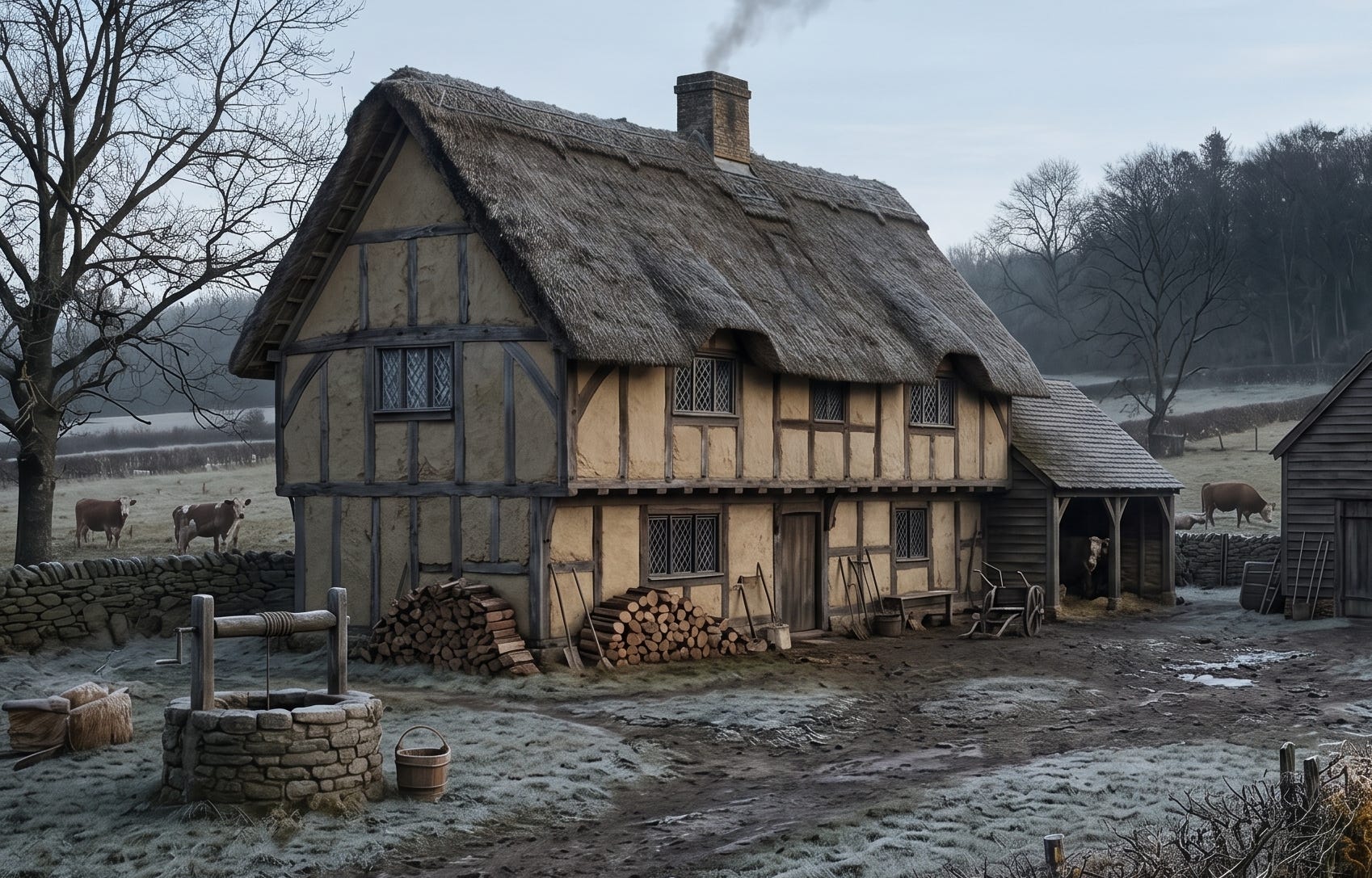
The light at the shutters was full now. A grey light, bleached and ordinary, the light of any October morning in the year of our Lord 1653 in a house that had stood through a long night and was still standing.
Edmund moved first.
He had been at the door through the rest of the night, his back against it, his palms flat against the wood. He straightened now, slowly, the way a man straightens after long labour, his breath going out of him in a sound that was not quite a word. He stood for a moment with his hand still on the boards. He did not speak. Will watched him from across the room and knew his father was praying or had forgotten how to pray and was waiting for the difference between the two to make itself known.
Then Edmund lifted the bar.
He did it slowly. He set the great length of oak down against the wall. He drew back the iron bolt at the top. He stood with his hand on the latch for the space of three breaths, listening, and then he opened the door.
The yard was empty.
The frost lay across it in an unbroken sheet. The fence stood as it had stood. The byre door was closed. The well was where the well had always been. Beyond the yard the lower field was white and silent, and beyond that the wood was the wood, dark and still, the trees holding their own counsel as trees will. There was no print in the frost. There was no sign that anything had crossed the yard in the night. There was no sign that anything had stood at the fence.
Edmund stepped out into the cold.
He walked the perimeter the way he had walked the lines of camps when he was a younger man, the soldier’s walk, slow and methodical, his eyes on the ground. He went to the fence and laid his hand on the top rail. He went to the byre and looked inside and the cow was there, standing in her stall, eating from the manger as though no night had ever happened. He went to the woodpile. He went to the well. He stood for a while at the gate, looking out across the lower field toward the wood, and Will, watching from the doorway, could not tell what his father was looking for or whether he had found it.
When Edmund came back to the house his face had settled into something Will had not seen before. Not the soldier’s face exactly. Something quieter. The face of a man who has set his accounts in order and has decided what he can afford to know.
“Nothing,” he said, as though it were a complete sentence. He said it as though it were the only sentence available to him.
He came back across the yard and into the house. Will was standing by the settle with Bess still in his arms, her head against his shoulder, her hair against his cheek. Edmund stopped at his son’s side. He did not speak. He looked down at his daughter for a long moment, his face doing the small private work that fathers do when no one is watching them and one of them is. Then he reached out and laid his hand on her hair. He left it there. The hand was rough from the night, from the bar and the iron, from his palms against the boards through the long hours, and it lay against the soft of her head with the awkward gentleness of a man who is not given to such gestures and is making one now because no other gesture will hold what he has to give. He stood a moment longer before he drew the hand back. He turned and went to his tools.
Inside, Will laid Bess down on the settle by the fire. She did not wake. She had not woken through the lifting of the music and she did not wake now, her small face soft in the firelight, her breathing even. Alice came and put a blanket over her. She tucked the blanket close at Bess’s shoulders, smoothed it down at her feet, stood for a moment looking at her daughter. Then she turned, went to the fire, and began to build it up.
She did not speak.
Will thought she would speak. He waited for her to do so. There were words owed in the room, words about the night, words about what had come and what had been kept out, the prayers his father had used and the iron she had laid and the music that had not finished what it had begun. He waited for any of it. His mother knelt at the hearth, laid the kindling, struck the flint. The small flame caught and grew. She fed it patiently the way she had fed every fire of every morning of his life, and she did not speak.
Will sat on the settle with his sleeping sister against his side. Bess’s head was warm against him. Her breathing was even. Outside, somewhere off in the wood, a crow called once and was answered. The fire took.
The question had been sitting in him since the music had lifted. He let it out now, quietly, because the room was quiet and because Bess was asleep and because the asking of it felt like something he was permitted at last.
“Mother,” he said. “Why are they called Good?”
Alice did not turn from the fire.
For a long moment he thought she would not answer. Her hands were busy with the small work of feeding the flames, a sliver of kindling, another, the breath she gave them between. Then she spoke, her voice low, almost as though she were speaking to the fire rather than to him.
“Because to name them truly is to call them,” she said. “We do not call them what they are. We call them by a kind name and hope to be passed over.”
Across the room Edmund’s hammer paused.
His father had been working the bent nail at the door, drawing it slow. The small steady sound of the work had been the floor of the room since they had come in from the yard.
“Sometimes,” Alice said, still to the fire, “they are called the Fair Folk. Sometimes the Gentry. Sometimes only Them, or the Others. My grandmother would not say any of it after dark. She would touch the iron at the door and say nothing at all.”
“Alice.” Edmund’s voice was low and short.
She did not turn.
“Iron at the threshold,” she said. “Salt at the sill. A pair of open scissors on the cradle of an unbaptised child. Rowan above the byre door. These are the old things. These are what my mother taught me and your great grandmother before her.”
“They were demons.” Edmund had set the hammer down. He spoke from across the room, the way a man speaks when he has decided he must speak and would rather not. “Whatever your mother taught you, Alice. Whatever your grandmother would not say. They were demons, and it was the Lord that drove them off, and there is no other reading of the night that does not lead a Christian soul into the dark.”
Alice’s hands were still at the fire.
“As you say, husband.”
“It is not as I say. It is as it is.”
“As you say.”
The fire cracked. Edmund stood for a moment looking at his wife’s back, and Will watched his father’s face, and his father’s face did the thing it had done by the byre that morning, the settling, the deciding what could be afforded. Edmund picked up the hammer. He went back to the bent nail. The small steady sound of the work resumed.
Alice fed the fire.
After a while, so quietly that Will almost did not hear it, she spoke again. Not to Edmund. Not quite to Will. To the flames, perhaps, or to the long line of mothers behind her who had said these things over their own fires.
“They take what they want,” she said. “And sometimes they leave something in its place. Sometimes a child is taken and returned, and the child that is returned is the child. Sometimes a child is taken and returned, and the child that is returned is not.”
Edmund’s hammer did not pause this time. Either he had not heard her, or he had decided he had not heard her. Will sat with his sister warm against his side, and the words his mother had spoken sat in him without yet finding the place they would sit in, the way a stone dropped into deep water has not yet reached the bottom.
He looked down at Bess. Her face was soft in sleep. Her lashes lay against her cheek. She was Bess. She had been with him through the night, against his side, his hand over her ear when the music came. He had held her. He had held her the whole time.
He carried his sister up the loft ladder.
He had not done it since she was very small. She was heavier now than she had been then, but she was still small enough, and he managed her up the rungs one-handed, her head against his shoulder, her hair against his cheek. He laid her down on her own pallet under her own blanket. He stood looking at her for a long moment in the dim light of the loft. She looked like Bess. She was Bess. He went back down the ladder.
The morning began to assemble itself.
Edmund had already moved into the work of repair. He fetched his tools from the chest by the wall and laid them out on the table in the old order, the order Will had known since he was a boy. Hammer. The smaller hammer. The leather pouch of nails. The plane. He took down the broken board from the side shutter and held it up to the light and turned it over and set it aside. He spoke as he worked. Practical things. The shutter wanted a new board out of the elm in the byre. The iron at the door had held but the head of one nail was bent and should be drawn and replaced. The bar was sound. The hinges were sound. He named each thing as he found it sound or wanting and Will listened and felt the shape of his father returning through the work the way a man returns to a familiar room.
This was how Edmund had come back from the war.
Will had not understood it at the time. He had been small. He remembered only that his father had been gone and then his father had been home, and the home version of his father had sat for a long while at the table not speaking, and then one day he had got up and fetched his tools and begun to mend the gate. The mending of the gate had taken several days. After the gate there had been the byre roof. After the byre roof there had been the fence on the south side. Will understood now what he had not understood then. The work was the way through. The work was what stood between a man and the thing he could not look at directly.
Alice did not join the work.
She sat at the fire. Her back was straight, her hands folded in her lap, her eyes on the flames. The morning went on around her. She did not move. Will watched her from the corner of his eye as he held the new board for his father at the shutter. Once or twice he thought she would turn. She did not.
There was a thing none of them said.
None of them said whether it would come back. None of them said the night out loud. They had decided, without deciding, to put the night inside the house and close the door on it. Now they were each in their own way building the door. Edmund at the shutter with his hammer. Will holding the board steady. Alice at the fire with her back turned. The unspoken sat in the room with them. They worked around it and did not look at it directly. Will understood that this was how it would be now. This was the shape the house would take. His mother knew something his father did not yet know. She would not say it.
He looked at her across the room.
She turned her head.
Her eyes met his. The look held a beat too long. Something passed across her face that he could not read, a shadow, gone before he could name it. Then she turned back to the fire.
Edmund set the hammer down.
“I had best look at the loft shutter,” he said. “If the side board has gone the loft will be the next.”
He crossed to the ladder. Will watched him climb, slow, the climb of a man whose body had been at the door all night and was paying for it now. He went up out of sight into the dim of the loft. The sound of his boots on the boards above them. The sound stopped. For a long moment there was no sound at all, only the stillness of a father standing watch over his sleeping child. Will stood holding the new board against the side shutter and did not look up. He knew his father had not gone to look at the shutter.
After a while Edmund came back down the ladder. He came down the way he had gone up, slow. He did not say what he had seen at the loft shutter, whether sound or wanting, and Will did not ask. Edmund crossed to the table and picked up the smaller hammer.
The morning went on.
By the middle of the morning the shutter was mended, the iron at the door had been drawn and replaced, Edmund had been out twice to the byre and once to the well. The cow had been milked, the milk was on the table in the pail, next to the bread, and the four of them sat down to eat.
Bess had come down the ladder on her own.
She had come down in her day-clothes, her hair brushed, her face washed. She had come down quietly, the way a child comes down the morning after a bad night, tired-quiet, soft-quiet. She had taken her place at the table without being told. Alice had set a piece of bread before her and a cup of milk, and Bess had said thank you in a small clear voice, and had begun to eat.
Edmund was talking.
The words came out of him steady and practical. The shutter was mended but the hinges of the byre door wanted oiling. The wood at the back of the woodpile was wet and would have to be brought out and stacked under the eaves. The cow had eaten well. Tomorrow he would walk the south fence. He had been meaning to walk it for a week. The post at the corner was leaning and would have to be reset before the ground hardened.
He spoke and ate and spoke and Will understood. The soldier after action who must speak and keep speaking because the alternative was the silence and the silence was not yet survivable.
Alice had set the bread out and poured the milk and then she had gone back to the fire. She had not eaten. She stood now with her back to the table, stirring something in the pot that did not need stirring, her shoulders set, her head slightly bent.
Bess ate her bread.
Will watched her. He could not help it. He watched her over the rim of his cup and could not look away. She was eating the way she always ate, small bites, careful, her hand small on the bread. She was sitting the way she always sat, her feet not reaching the floor, swinging a little. She was Bess. The shape of her was Bess. The hair against her neck was Bess’s hair. The freckle at the corner of her mouth was the freckle he had known for six years.
She looked up.
She looked at him across the table.
She smiled.
The smile arrived a half beat late.
It arrived as a smile arrives on the face of someone who has been told that this is what a smile is, and is doing it well, and is doing it with care, and is doing it not quite at the speed at which a smile happens on the face of a child who is six years old and is smiling at her brother across a table on an ordinary morning.
Her hand crossed the table.
Small. Careful. Her fingers found his where his hand rested by his cup. Her fingers closed over his.
Her fingers were cold.
Outside the window a bird was singing. Edmund was talking about the post at the south corner. Alice at the fire had her back turned and the spoon in her hand was moving in the pot. Bess was holding Will’s hand and her fingers were cold and Will sat in the morning light and could not speak and could not move.
He looked at his mother’s back.
He looked at his father’s mouth, still moving, still speaking, the words coming out of him steady and practical and far away.
He looked at his sister’s face.
She was still smiling.
She was waiting for him to smile back.

Beautiful evocative storytelling. The details of that morning scene in 1653 create such a vivid, atmospheric tension. Looking forward to following The Good Folk series.
The last part of the story where Will was watching Bess, noting her smile being out of synch, and the coldness of her touch, sent chills up my arms and down my spine.