
Nocturnal Me

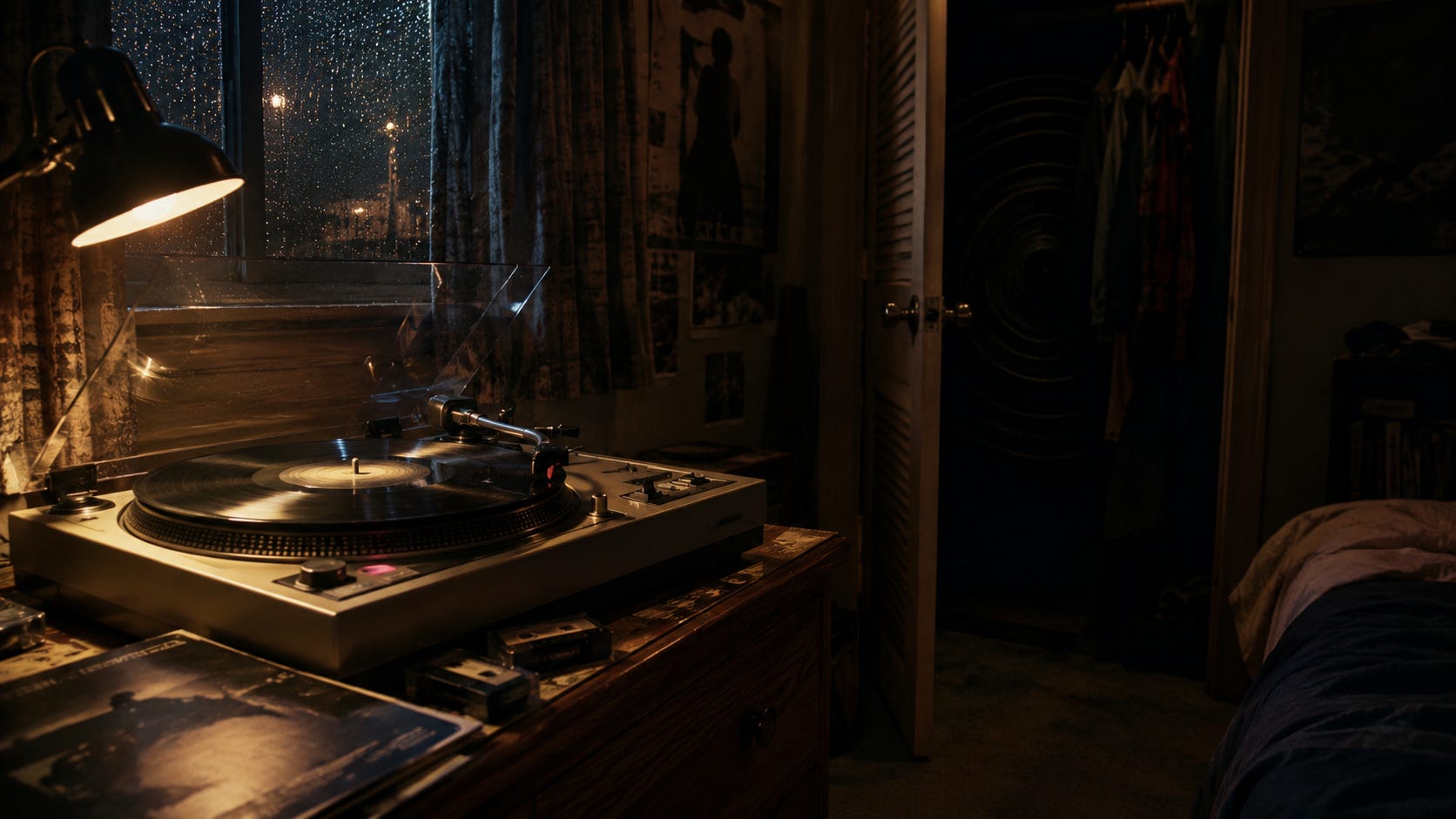
The needle found the groove and Danny closed his eyes.
Ocean Rain was a ritual, not just a record. He’d owned it since he was fourteen, a battered copy from the second-hand bin at Fallout Records on First Avenue, the sleeve worn soft from handling. Three years of being loved. There was a crease at the top right corner from when he’d knocked it off the dresser and he’d never tried to flatten it because the crease was part of it now, the same way the faint smell of cigarettes was part of the Technics. The turntable had been his father’s, and on certain quiet evenings, when the rain was steady and the house felt most like itself, Danny could almost feel the machine watching him.
He told himself that was stupid.
McCulloch’s voice filled the room and the rain sealed the window and for a few minutes the bedroom was the only place in the world. His mother was downstairs, doing the thing she did in the evenings: sitting somewhere that wasn’t quite here.
He thought about Marie. They’d seen The Lost Boys together at the Crest in August, back row, her knee against his in the dark, and when the Echo and the Bunnymen cover started, people are strange when you’re a stranger, she’d leaned into him in a way that meant she understood something. He’d bought the soundtrack cassette the next day.
He’d been playing Lips Like Sugar a lot since August. Marie’s song, from the new self-titled album, and he’d worn something into it already. Tonight his hand had gone past it to Ocean Rain without quite deciding to. The Killing Moon. Fate up against your will.
He’d read about backmasking in a magazine, playing a record backwards. Judas Priest, the Beatles, Led Zeppelin: hidden messages pressed into vinyl by shadowy hands, audible only in reverse. Danny thought it was stupid. He knew the word pareidolia: the brain finding faces in wood grain, meaning in noise. He was proud of knowing it.
He thought about the article for three days.
He lowered the needle onto Silver, the first track, and turned the platter backwards by hand. The sounds were what he expected: vowels stretched wrong, the music’s skeleton inverted into something that didn’t want to be heard.
Then a voice said his name.
Daniel.
He lifted the needle. The room was very quiet. He could hear rain and his own breathing and, underneath both of those, something that might have been the house settling but wasn’t.
He put the needle back.
Daniel.
It wasn’t quite a human voice. It was the shape of a voice, assembled from available materials. Pareidolia, he told himself. The word felt smaller than it had a week ago.
He played the second track backwards.
The voice said his street. His precise number. Spoken with the patience of something that had simply always been ready.
Danny sat on the edge of the bed with the sleeve in his hands and read the track listing until the letters stopped meaning anything.
Track two: Nocturnal Me.
He’d read those words a hundred times. He hadn’t seen them until now.
He waited until 2am. The house carried the silence of a held breath.
He lowered the needle onto Crystal Days, the third track, and turned it back.
The voice described his closet. The drawings on the back wall behind the hanging clothes: a house, a sun, a small figure with arms spread, and beside it a larger figure with a cross gouged through it, scored down through the paint to the drywall, a groove he’d made with a pencil until the pencil was gone and then with a key. The drawings no one had ever seen. That he’d almost forgotten, until now.
The bedroom had been a refuge since he was twelve. Now it was something else. A place that knew him in all directions, including back through time, including the version of him who had sat in the dark behind hanging clothes and tried to make himself small enough to disappear.
He read the sleeve again. Silver. Nocturnal Me. Crystal Days. And at track six:
The Killing Moon.
He left the needle where it was. He didn’t play track six that night. He moved to the far wall, put his back against it, and kept the desk lamp on. He didn’t look at the record player. He thought about the drawings instead — when he’d made them, what age he must have been, the precision of that crossed-out figure, how much intent there was in a child’s hand scoring through drywall. Around 4am he thought about opening the closet and checking, just to check, and then didn’t. He sat there until the window greyed with morning and told himself he hadn’t slept because he wasn’t tired.
He wondered, sometime before dawn, if it had always been there. Not waiting to be found, exactly. Waiting until he was old enough to understand what it had heard.
He lent Ocean Rain to Kyle on Friday. Kyle brought it back Sunday. He’d heard nothing backwards but Bunnymen and hiss.
Marie didn’t call Monday. She didn’t call Tuesday. Danny rode his bike through the rain and Mrs Ellison said Marie had gone to Tacoma, it had been planned for a while, hadn’t Marie mentioned it?
Danny rode home and stood in the doorway of his bedroom for a long time. The Technics sat where it always sat. The hallway light timed out and left him standing in the dark.
Then he went in and lowered the needle onto The Killing Moon and turned it back.
The voice described November 1980. Danny was ten years old. His father had come home wrong. That specific quality he’d learned to read from the sound of the front door, the drag of footsteps on the stairs, the stillness that preceded whatever came next. He’d gone to the closet and pulled his father’s old coat around himself and pressed his back against the drawings in the dark.
He hadn’t thought I wish he would die.
He’d thought: I wish he wasn’t. His father as a problem that could be made not to exist, cleanly, without a name for the space left behind. He’d thought it with everything he had, in the dark, with the coat around him and the cross gouged in the wall at his back.
His father was gone by January. The police came and asked questions and his mother answered them and eventually they stopped coming, and the world arranged itself around the absence the way it always does.
Danny had never told anyone what he’d thought in the closet. He had built everything on top of that silence.
The voice said: I heard you.
The rain. The house. A long pause that had no bottom.
Tell her.
The needle lifted by itself, set back down, and The Killing Moon began again from the beginning, playing forward this time, McCulloch’s voice filling the room. Fate up against your will. Through the thick and thin.
Danny stood up and went downstairs.
The kitchen light was too bright. His mother sat at the table with tea she wasn’t drinking, somewhere else inside herself. She’d been this way since 1980. Danny had learned not to examine the shape of it too closely.
He sat down across from her.
From upstairs, barely: the record player, still running.
“Mom.”
She looked up.
“I need to tell you something. About before Dad…disappeared.” The word still sat wrong after all this time. “I was in the closet. You know how I used to go in there.”
She said nothing. Watching him with an expression he couldn’t name.
“I was in the dark and I was angry and I thought—” His voice was unsteady. “I didn’t think die. I need you to understand that. I just thought I wish he wasn’t. And then he was gone. And I think something heard me. I think it did something. And I think it wants you to know.”
The kitchen held the silence.
His mother looked down at her cup. When she looked back up her eyes were wet, but her face was not the face of someone surprised.
“I hear things,” she said quietly. “At night, mostly. In the hallway. In this kitchen when I’m sitting alone.” She paused. “I’ve told myself it was grief. That losing someone like that does things to you. But it’s been seven years, Danny.” Her hand moved on the table, not quite reaching for him. “I think I’ve been waiting for you to say what you just said.”
The floor dropped out of something in Danny’s chest.
“It’s been in the house this whole time?”
She looked older in that moment than Danny had ever seen her. Not tired in the familiar way, but stripped — like she’d been holding a particular arrangement of her face for seven years and had just now let it go.
“Why didn’t you say something?” Danny asked.
“To you?” She almost smiled, and it didn’t reach anywhere. “You were ten years old. And then you weren’t ten anymore, and it seemed — I kept thinking if neither of us named it, it would just—” She stopped. “I don’t know what I thought.”
“I wished it too,” she said. “Before you were old enough to wish anything. A hundred times in this kitchen, in that bed. I wish he wasn’t.“ Her voice careful now. “I think we both called it.”
From upstairs the music stopped.
The quiet that followed was one Danny recognised from the closet. It was not empty. It had the quality of something listening after being answered.
“What does it want now?” his mother asked. She wasn’t asking him.
Neither of them moved for a long time.
Marie called Wednesday. Her aunt had needed her, it had all been very sudden, she was sorry she hadn’t called sooner.
Danny said he was glad she was back.
He stood at the window while they talked, watching the rain on the street below, letting her voice do what it did. When they said goodnight he held the phone for a moment after she hung up, in no hurry to put it down.
Then he turned back to the room.
The desk lamp threw the same low light it always did. The sleeve lay on the dresser where he always kept it. Everything exactly where he’d left it, the room ordinary in every direction.
Ocean Rain was still on the turntable, where he’d left it Tuesday night. The label visible in the soft glow, the platter still.
From inside the closet came the faint, unmistakable sound of a needle finding a groove.
Not music. The opening seconds only — the hiss of a record already turning, the pause before whatever came next. Behind a closed door, in a dark space, with nothing in there that could make that sound.
Danny didn’t move toward it. He stood in the middle of his bedroom, his father’s old coat still hanging inside that door, the drawings still on the back wall behind it, and something that had been there since 1980, in the dark, waiting.
Patient the way it had always been patient.
Waiting for him to open the door.
