
Peripheral
A Tale from the Uncanny Valley

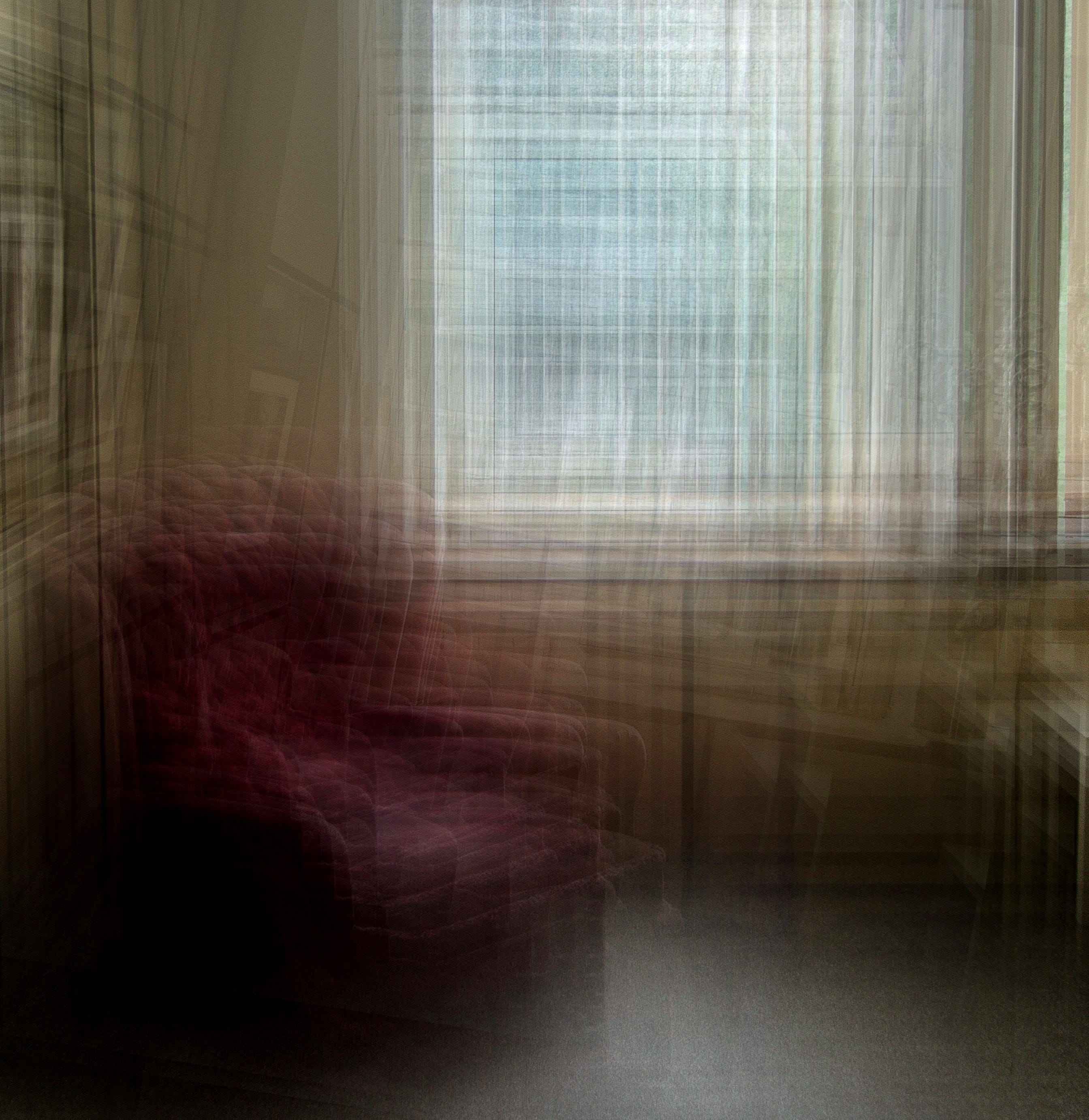
The kitchen smelled wrong.
Not bad. Just wrong. Like someone had tried to recreate the scent of Gran’s cooking from a description rather than memory. Onions and something sweet, but the proportions were off. Too much of one, not enough of the other.
Daniel stood by the table and tried to place what was bothering him. The tiles were the right colour, that cream-yellow Gran had loved. The window over the sink looked out onto the garden, roses climbing the fence just like they should. But something about the way the light fell through the glass felt flat. Painted, almost.
Dreams were like that, though. Close but not quite. He’d had this one before, or versions of it. Gran’s kitchen. The place he’d come back to in his head when things got bad. Safe. Warm.
He heard her humming from somewhere deeper in the house. That old song she used to sing whilst she worked. The melody was right, but it seemed to skip, like a recording with a scratch in it.
The back door opened.
Grandpa had to duck to get through, even though the door frame was tall enough. Daniel frowned. Had he always been that tall? He must have been. Must have. Dreams pulled things from childhood, and children saw adults as giants.
But there was something off about the proportions. Grandpa’s head nearly brushed the ceiling, his shoulders broad enough to fill the doorway. But his hands, hanging at his sides, looked small. Too small for a man that size.
“Bit dark in here,” Grandpa said. His voice was flat. Cold. The way it always was. He crossed to the window and adjusted the curtain, not asking, just doing. Taking control of the space the way he always had.
Gran appeared in the doorway to the hall, wiping her hands on her apron. “I like it that way, Tom. Not too bright.”
“Well it’s too dark.” Grandpa didn’t look at her. He moved a cup from the counter to the table, then moved it back. Rearranged the salt and pepper shakers. “You’ll strain your eyes.”
Gran’s smile didn’t reach her eyes. “Yes, Tom.”
Daniel felt that old tightness in his chest. The walking-on-eggshells feeling. He’d forgotten that part. Funny how memory worked. You kept the kitchen, the roses, the humming. You tried to forget the rest.
But dreams didn’t let you forget. Dreams dragged it all up.
He looked at Grandpa again. The height thing was really bothering him now. And there was something about the way he moved. Too smooth. Like he was gliding rather than walking. His shadow stretched across the floor at an angle that didn’t match the window light.
Something else was wrong too. Daniel couldn’t quite place it at first. Then he realised. When he looked directly at things, they were clear. Sharp. But at the edges of his vision, everything felt incomplete. Blurred. Like the world only bothered to render itself properly when he was looking straight at it. When he tried to catch the details in his peripheral vision, they smeared. Lagged behind. Like his eyes were moving through syrup.
Dreams did that sometimes, didn’t they? You could never quite see the edges. Never quite trust what wasn’t right in front of you.
“Why are you here?” Daniel said.
Grandpa turned. Looked at him for the first time. His eyes were blue. They’d always been blue, Daniel was sure of that. But the shade was wrong. Too bright. Almost violet in the kitchen light.
“I live here,” Grandpa said.
“No. I didn’t want you here.”
Gran laughed, but it sounded forced. Mechanical. “Don’t be silly, love. Of course he’s here. Where else would he be?”
Daniel opened his mouth to argue, then stopped. Where else would he be? This was Gran’s kitchen. Grandpa had lived here. Just because Daniel didn’t want to see him didn’t mean he wouldn’t show up. That was how dreams worked. They didn’t listen to what you wanted.
He tried to look away from Grandpa, focus on something else. The calendar on the wall caught his eye. It was one of those old-fashioned ones with a different painting for each month. But the image was wrong. A countryside scene, rolling hills and a farmhouse, except the perspective was off. The hills seemed to curve upward at the edges, like they were wrapping around something. And the farmhouse had too many windows. He counted them. Seven on the front face. No. Eight. No, seven again. They kept shifting when he wasn’t looking directly at them.
When he glanced away from the calendar, towards the window, the edges of the garden blurred. Smeared. Like wet paint dragged across canvas. He turned his head to look properly and the garden snapped back into focus. Roses. Fence. Sky.
But the periphery. Always the periphery felt wrong. Incomplete.
“Daniel, love, would you like some tea?”
Gran was at the stove now, kettle in hand. But she hadn’t filled it. Hadn’t turned on the tap. She just stood there, holding the empty kettle over the burner, smiling at him with that patient, waiting expression.
“You need to fill it first,” he said.
She looked down at the kettle, then back at him. “Of course. Silly me.”
But she didn’t move. Just kept standing there, kettle poised over the unlit burner. Her smile didn’t waver.
“Gran?”
“Hmm?”
“The kettle.”
“Yes, love. Tea in just a moment.”
Grandpa made a sound. Might have been a sigh, might have been something else. He pulled out a chair and sat at the table. The chair creaked under his weight, a long, drawn-out groan that went on too long. When he settled, his knees were higher than they should be. Like the chair was too small, or he was too large, or both at once.
Daniel felt the panic starting to build. That dream-panic, where you knew something was wrong but you couldn’t quite articulate what. Where the world was breaking its own rules and everyone else was acting like it was fine.
He needed to wake up.
That was it. Simple. Just wake up. He’d done it before, forced himself out of bad dreams. You just had to realise you were dreaming, and then you could pull yourself out.
He pinched his arm. Hard. Felt the pressure, felt his fingers digging into flesh. But nothing changed. The kitchen stayed exactly as it was. Gran still holding the empty kettle. Grandpa too tall in his too-small chair.
He tried again. Harder this time. Hard enough that it should hurt, should shock him awake. But the pain was distant. Muffled. Like his arm belonged to someone else.
“Something wrong?” Grandpa’s voice cut through his rising panic.
Daniel looked up. Those too-blue eyes were fixed on him, unblinking. Had he blinked at all since he’d arrived? Daniel couldn’t remember seeing it.
“I need to wake up,” Daniel said.
“Wake up?” Gran turned from the stove, still holding the kettle. “But you’ve only just got here, love.”
“This is a dream. I need to wake up.”
Grandpa leant back in his chair. The motion was too fluid, like he had an extra joint in his spine. “If it’s a dream, why does it matter? Just enjoy your visit.”
“I didn’t want you here.”
“You keep saying that.” Grandpa’s voice was still flat, still cold. But there was something underneath it now. Amusement, maybe. Or irritation. “Yet here I am.”
Daniel closed his eyes. Counted to ten. Another technique. You close your eyes in a dream, count, and when you open them you’re awake. It had worked before. It had to work now.
One. Two. Three.
He could still hear Gran humming. That skipping, scratched melody.
Four. Five. Six.
The smell of the kitchen. Onions and sweetness and something else now. Something metallic.
Seven. Eight.
Grandpa’s chair creaking. That long, impossible groan.
Nine. Ten.
He opened his eyes.
The kitchen was gone.
He was standing in the lounge. The one at the front of the house, with the bay window that looked out onto the street. But he’d never been in this room. Never uploaded photos of it. He’d kept his memories selective. Kitchen. Garden. The small sitting room at the back where Gran would do her crosswords.
Not this room.
The furniture was wrong. A sofa he didn’t recognise. A coffee table with a glass top that reflected the ceiling light in fragmented, impossible angles. And against the far wall, underneath the window, a hospital bed.
Gran was in it.
Not the Gran from the kitchen. Not the one humming and holding an empty kettle. This Gran was small. Shrunken. Her hair thin and grey against the pillow. Her hands resting on top of the blanket, veined and liver-spotted and too still.
A woman in a dark blue uniform stood beside the bed, checking something on a chart. District nurse. That’s what they called them. Daniel knew that, even though he’d never seen one in this house. Dreams gave you knowledge you shouldn’t have.
The woman looked up as he entered. Smiled.
Her eyes were green. Not blue-green or hazel. Properly green. Almost neon. Like they’d been coloured in with a highlighter pen. They glowed faintly in the dim light of the room, and they were too wide. The space between them and the edges of her face stretched wrong, like the proportions had been measured incorrectly.
“Hello, Daniel. Come to see your gran?”
He couldn’t answer. Couldn’t look away from her hand as she reached for a pen clipped to the chart. Six fingers. No. Seven. They moved independently, each one flexing and curling as she wrote something down. The motion was fluid but wrong, like watching an octopus tentacle pretending to be a hand.
“She’s been asking for you,” the nurse said. Her voice was pleasant. Soothing. But it had that same mechanical quality as Gran’s in the kitchen. Pre-recorded. Looped.
Daniel forced himself to look at the bed. At Gran. Her eyes were closed. Her chest rose and fell in shallow, irregular breaths.
The periphery again. When he glanced towards the window, the street beyond became a blur. A smear of grey and brown. Houses that weren’t quite houses. Trees that were more suggestion than shape. He turned his head to look directly and they snapped into focus. Brick. Windows. Branches.
But always, at the edges, that incomplete feeling. That sense of the world struggling to keep up.
“What’s wrong with her?” he asked.
“Old age, love.” The nurse’s smile widened. Those neon-green eyes never blinked. “It comes for us all.”
Footsteps behind him. Heavy. Deliberate. Daniel turned.
Grandpa stood in the doorway. Even taller now. He had to bend almost double to fit through the frame, his spine curving at angles that shouldn’t be possible. When he straightened, his head nearly touched the ceiling.
“Bloody useless now, isn’t she?” Grandpa said. His voice was ice. He moved into the room, that gliding motion, his too-small hands hanging at his sides. “Can’t cook. Can’t clean. Just lies there like a sack of meat, draining the life out of everyone.”
“Don’t talk about her like that,” Daniel said.
Grandpa’s too-blue eyes fixed on him. “Why not? It’s the truth. She’s a burden. Always has been, really. But at least before she could make herself useful. Now?” He gestured at the bed with one small hand. “Now she’s just waiting to rot.”
The nurse kept smiling. Kept writing on her chart with those impossible fingers. Like this was normal. Like Grandpa’s viciousness was just background noise.
Gran’s eyes opened. Slowly. Like it took effort. They found Daniel, and for a moment there was recognition there. Something real.
“Danny?” Her voice was barely a whisper.
“I’m here, Gran.”
“Why did you leave me with him?” She sounded so small. So lost. “You knew what he was like. You knew.”
The words cut through him. Because it was true, wasn’t it? He had known. He’d grown up watching Grandpa belittle her, control her, strip away pieces of her until there was nothing left but compliance. And when Daniel had grown up, moved away, he’d left her there.
“I’m sorry,” he said.
“Sorry doesn’t help her now,” Grandpa said. He moved closer to the bed, looming over it. Over her. “She’s mine. Always has been. And you? You’re just visiting. A tourist in someone else’s misery.”
The nurse looked up from her chart. Those glowing green eyes fixed on Daniel. Unblinking. Inhuman.
“Your gran’s very tired. Perhaps you should let her rest.”
“I want to stay.”
“That’s not really an option.” The nurse’s smile never wavered. “Visiting hours are over.”
“This is a dream. There are no visiting hours.”
The nurse tilted her head. That smooth, camera-pan motion. “Are you sure it’s a dream, Daniel?”
The question hung in the air. Daniel felt the panic rising again, faster now. Because the room felt too real. The smell of antiseptic and decay. The sound of Gran’s laboured breathing. The weight of Grandpa’s presence, crushing and cold.
This wasn’t a dream.
But it couldn’t be real either.
He looked at his hands. Tried to focus. If he could just concentrate, just force himself awake. He’d done it before. He could do it again.
He closed his eyes. Squeezed them shut so hard that colours burst behind his eyelids. Red. Purple. Gold. He focused on them, on the pressure, on the physical sensation of his own body rejecting this place.
Wake up. Wake up. Wake up.
He said it in his head like a mantra. Like a prayer. Felt his breathing quicken, felt his heart hammering against his ribs. The panic was good. Panic meant adrenaline. Adrenaline meant waking up.
The sounds of the room began to fade. Gran’s breathing. Grandpa’s heavy presence. The nurse’s pen scratching against the chart. It all receded, became distant, like he was moving away from it down a long tunnel.
His eyes snapped open.
White ceiling. Fluorescent lights. The hum of electronics.
Daniel gasped, sucking in air like he’d been drowning. His body felt heavy. Wrong. There was pressure on his chest, around his head. He tried to lift his arm and felt resistance. Straps. No. Cables. Sensors.
He was lying down. Flat on his back. The helmet. He could feel it now, the weight of it pressing against his skull. The visor was still down, but the feed had cut. Just darkness and the faint afterimage of the lounge burned into his vision.
Relief crashed over him. So intense it almost hurt. He was out. He was awake. It had just been the programme. Just the VR. A nightmare rendered in code.
“Easy. Take it slow.” A woman’s voice. Close. Concerned.
Daniel turned his head. She was standing beside the chair, reaching for something on the console. Dark blue scrubs. Blonde hair pulled back in a ponytail.
“How are you feeling?” she asked. “You pulled yourself out quite abruptly. That’s not recommended.”
“I’m fine.” His voice came out rough. Dry. “Just needed to stop.”
“Of course. Completely understandable. First sessions can be overwhelming. The neural feedback can be quite intense.” She moved closer, reaching for the helmet’s release mechanism. “Let me get this off you.”
Her hand came into view.
Seven fingers.
Daniel’s breath caught.
No. Six. No. He couldn’t count them. They moved wrong, flexed wrong, the joints bending at angles that didn’t make anatomical sense.
“Hold still,” she said.
He looked up at her face.
Those eyes. Green. Neon green. Too wide. Too far apart. Glowing in the sterile white light of the room.
It was her.
The same nurse. The same impossible proportions. The same wrongness.
“No.” The word came out strangled. “No, no, no.”
“Daniel, you need to stay calm.”
“You’re not real.”
Her smile was patient. Understanding. The exact same smile she’d worn in the lounge. “I’m very real. You’re just disoriented from the session. That’s normal. Your brain is still processing the transition between environments.”
He tried to sit up, but the straps held him down. Not straps. Cables. Dozens of them, snaking from the helmet, from pads on his chest and arms, all connected to the humming machines around the chair.
The room looked real. Felt real. White walls. Equipment racks. A door with a small window showing a corridor beyond. A normal VR lab. Except.
Except the corners of the room didn’t quite meet properly. The angles were wrong. And the fluorescent lights overhead flickered in a pattern. Not random. Rhythmic. Like a heartbeat.
And the periphery. When he tried to look at the equipment racks without turning his head fully, they blurred. Smeared. Details dissolving into vague shapes and colours that only resolved when he looked directly at them. The world lagging behind his gaze.
“Where am I?” Daniel asked.
“You’re in the Immersion Lab. Where you’ve been for the last forty-seven minutes.” The nurse’s too-many fingers worked at the helmet’s clasps. “We’re going to get you disconnected and then you can rest. There’s some water in the recovery room.”
“This isn’t real.”
“Daniel.” Her voice was still patient. Still kind. But there was something else underneath now. Something that made his skin crawl. “You’re experiencing a common post-immersion dissociation. It will pass. You just need to give yourself time to reorient.”
She lifted the helmet off his head.
The room stayed exactly the same.
The fluorescent lights kept their rhythmic flicker. The corners stayed wrong. The periphery stayed incomplete, blurred, always one step behind wherever he looked. And her eyes, those too-wide glowing green eyes, stayed fixed on him with that endless, mechanical patience.
“You’re doing very well,” she said, setting the helmet aside with those impossible fingers. “Just a few more minutes and you’ll feel much better.”
Daniel stared up at her. At the wrongness of her. At the wrongness of everything.
He hadn’t woken up at all.
“I need to leave,” Daniel said. His voice was steadier than he felt. “Now. Open the door.”
The nurse’s smile didn’t change. “Of course. But first we need to complete the post-session checklist. Standard procedure. Just a few questions.”
“No. I want out. Now.”
“Daniel.” She reached for a tablet on the equipment rack. Those fingers wrapped around it, all seven of them finding purchase. “I understand you’re distressed. But leaving before the cognitive assessment could be dangerous. We need to ensure you’re stable.”
He wasn’t listening. He was already working at the cables attached to his chest, yanking at the adhesive pads, pulling them free. The machines behind him started beeping. Alarms. Warning tones.
The nurse’s smile finally faltered. “Daniel, please don’t do that.”
He swung his legs off the chair. Stood. The room tilted slightly, then righted itself. He moved towards the door, past the nurse, past her protests.
His hand found the handle. Turned it. Pulled.
The corridor beyond was white. Sterile. Fluorescent lights running along the ceiling in a straight line that seemed to go on forever. Doors on either side. Identical doors. Dozens of them.
He stepped out. Turned left. Started walking.
The corridor stretched ahead of him. Behind him. When he looked back, the door he’d come through was already gone. Just more identical doors. More white walls.
The periphery was worse here. When he walked, the corridor ahead stayed sharp, but everything to the sides dissolved. Smeared. Like reality was conserving its resources, only rendering what he was looking directly at. The doors became vague suggestions of doors. The walls became texture without detail.
He tried one. Locked. Tried another. Also locked.
His pace quickened. Walking became jogging. Jogging became running. The lights overhead flickered past in that same rhythmic pattern. Heartbeat. Pulse. The corridor never ended. Never curved. Never changed.
He stopped. Breathing hard. Turned in a circle.
Every direction looked the same. White walls. Identical doors. Lights that pulsed and flickered. And always, at the edges of his vision, that incomplete feeling. That lag. That sense of the world struggling to keep up with him.
A sound behind him. Footsteps. Multiple sets. Heavy. Deliberate.
He turned.
Grandpa stood at the far end of the corridor. Too tall. Joints bent wrong. And beside him, Gran. Not the shrunken version from the bed. The kitchen version. Still holding her empty kettle. Both of them watching him with those too-blue eyes.
And between them, the nurse. Those neon-green eyes glowing in the fluorescent light. Smiling. Always smiling.
They started walking towards him. That gliding motion. Not hurried. They didn’t need to hurry.
Daniel backed away. Found another door. This one opened.
He fell through it.
The kitchen.
He was back in the kitchen. The tiles. The window. The calendar with its shifting windows. The smell of onions and sweetness and decay.
Gran was at the stove. Grandpa at the table. The nurse by the door, her green eyes glowing softly.
“Welcome back, love,” Gran said, her voice that mechanical loop. “Would you like some tea?”
Daniel’s legs gave out. He sank to the floor. The tiles were cold against his palms. Real. Too real.
He looked up at them. All three of them. Watching him. Waiting.
The edges of the room blurred when he wasn’t looking directly at them. The window. The cupboards. The doorway to the hall. All of it incomplete. All of it struggling to render.
“How long?” he asked. His voice cracked. “How long have I been here?”
The nurse tilted her head. Consulted her tablet. Those impossible fingers swiping across the screen.
“Forty-seven minutes,” she said.
“That’s what you said before.”
“Did I?” She looked genuinely puzzled. Then smiled again. “Time moves differently in immersion. You might find the progression... non-linear.”
“What does that mean?”
But she didn’t answer. None of them did. They just stood there, in their positions, like actors waiting for their cue.
A sound from the hall. Footsteps. Light. Quick. Someone running.
The kitchen door burst open.
Daniel stumbled through it. Another Daniel. Younger, maybe. Or just less worn. His face wasn’t creased with panic yet. His eyes weren’t quite as wild.
The other Daniel stopped when he saw him. Stared.
“Who are you?” the other Daniel asked.
Daniel opened his mouth. Closed it. Tried again. “I’m you.”
“That’s not possible.”
“None of this is possible.” Daniel gestured at the room. At Gran with her empty kettle. At Grandpa in his too-small chair. At the nurse with her glowing green eyes. “But here we are.”
The other Daniel shook his head. Backed towards the door. “This is a dream. I just need to wake up.”
“It’s not a dream.”
“Yes it is. It has to be.” The other Daniel’s voice was rising. Desperate. “I just need to concentrate. I just need to—”
“You can’t wake up.” Daniel heard his own voice. Flat. Dead. “I’ve tried. I’ve tried everything.”
The other Daniel stared at him. At the defeat in his posture. At what he would become.
“No,” the other Daniel said. “No, I won’t accept that.”
He closed his eyes. Started counting. Daniel heard the numbers. Heard the determination in them. Watched his own past self trying the same useless techniques.
When the other Daniel opened his eyes, he was still there. Still in the kitchen.
His face crumpled. Just for a moment. Then he looked at Daniel again.
“How long have you been here?”
“I don’t know.” And that was the worst part. Daniel genuinely didn’t know. “I thought it was forty-seven minutes. But she keeps saying that. The nurse. Every time I ask, it’s always forty-seven minutes.”
The other Daniel looked at the nurse. At her patient smile. Her glowing green eyes that never blinked.
“What does that mean?” he asked.
“I think...” Daniel swallowed. The words felt like glass in his throat. “I think we’re looping. I think every time we try to leave, every time we think we’ve woken up, we just start again. A new iteration. A new version of us.”
“That’s insane.”
“Is it?” Daniel gestured at Grandpa. At his impossible height. At the calendar with its shifting windows. At the periphery of the room that blurred and smeared. “Is it really the most insane thing here?”
The other Daniel was quiet. Daniel could see him processing. See the moment the hope started to drain out of his eyes.
“There has to be a way out,” the other Daniel said. But he didn’t sound convinced.
“Maybe there is. Maybe one of us will find it.” Daniel stood. His legs felt weak. Distant. “But I don’t think it’s me. Not this version.”
The other Daniel looked at him. Really looked at him. At what waiting did to a person. At what being trapped in your own corrupted memory did.
“What do I do?” the other Daniel asked.
Daniel didn’t have an answer. He turned towards the door. Towards the hall and the impossible corridor beyond.
“Daniel, love,” Gran called from the stove. “Where are you going? Tea’s almost ready.”
He looked back. The other Daniel was staring at Gran. At the empty kettle. At the smile that never changed.
“I’m sorry,” Daniel said.
Then he walked through the door.
The corridor stretched ahead of him. White. Endless. The lights pulsed their rhythmic pattern. The edges blurred and smeared as he moved, the world struggling to keep pace with his gaze.
Somewhere very far away, he could hear the beep of a heart monitor. His heart. Still beating.
Still alive.
Still here.
Behind him, he heard the other Daniel start to count again. One. Two. Three. Still trying. Still hoping.
Daniel kept walking.
The corridor went on forever.