
The Grey Man

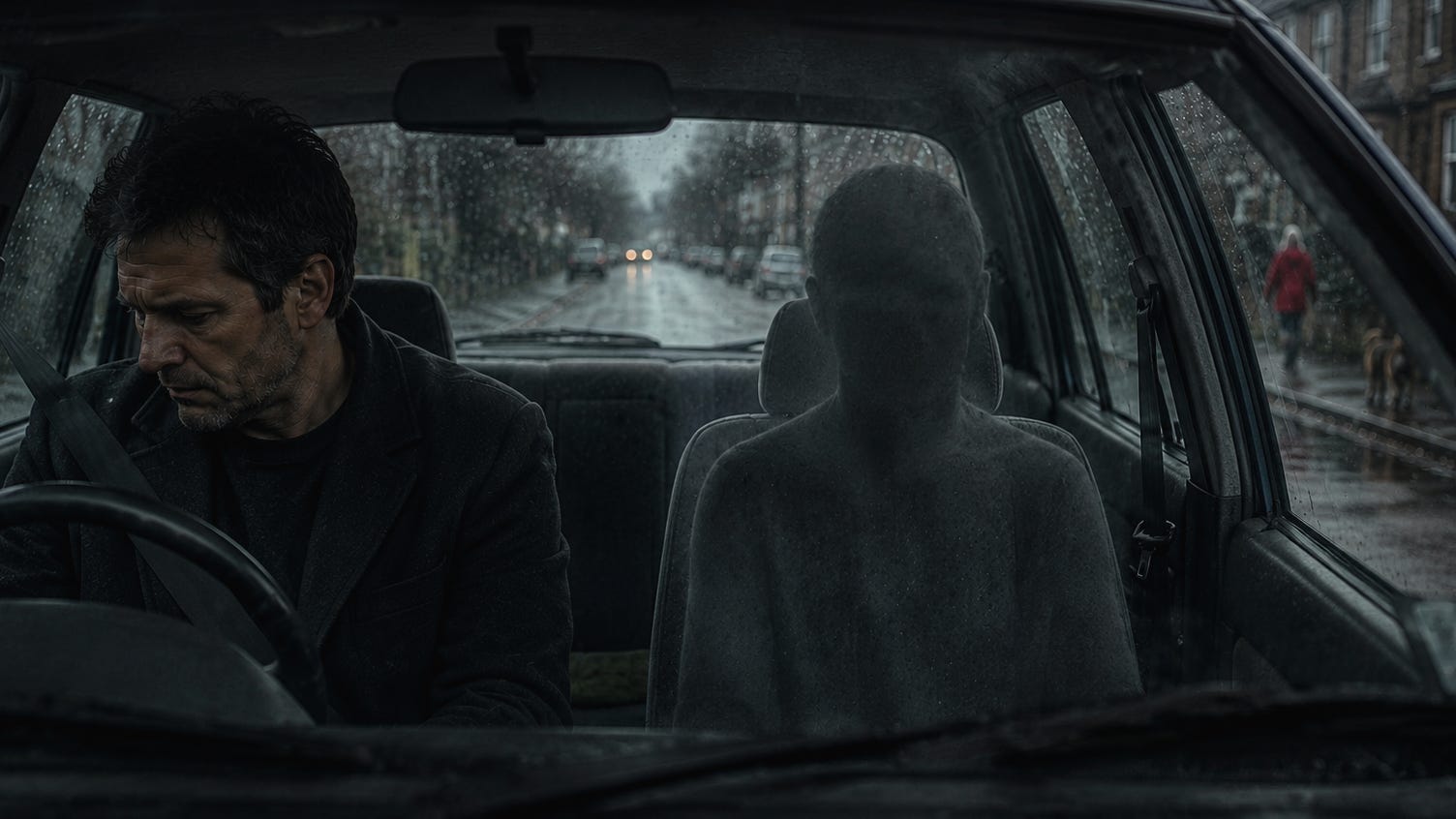
There were four Thursdays that week, though only one appeared on the calendar.
The first was the day I visited him.
The second was twenty years old and smelled of warm plastic, stale coffee, and the dust that collected behind CRT computer monitors.
The third stood in the corner of the room with its hands folded.
The fourth followed me home.
I am putting them in order now because order is one of the little kindnesses we pretend we still own. At the time they arrived together. Layered. One over another. Thursday through Thursday through Thursday, like tracing paper, like smoke behind glass, like the old transparencies teachers used to lay on projectors when they wanted a diagram to become more complicated than it had any right to be.
He would have laughed at that.
Not laughed properly. Not now. The laugh had become smaller. A dry movement in the nose. A little upward failure of breath. But it was still his laugh, or near enough to hurt.
By the third Thursday, I understood that grey was not a colour but a distance.
It sat between us on the bedspread, gathered in the glass beside him, in the unlit television, in the little plastic cup no one had thrown away. The hands had gone first, I think. Or perhaps I only noticed the hands because hands are where a person leaves himself when the face has become unreliable.
He was still there.
That was what I could not forgive.
If he had vanished entirely, I could have hated the absence. I could have blamed it. Given it teeth. Given it a name with a hard sound in it. But he had not vanished. He remained in pieces large enough to recognise and small enough to break me.
“You’re staring,” he said.
“I’m admiring the decor.”
“Liar.”
“It’s a very moving arrangement of beige.”
He made the old noise through his nose.
There. Him.
Then gone.
Not gone. That is too simple. Gone belongs to keys, signals, buses, people who leave the room and do not come back before the kettle boils. This was delayed. Arrival through poor weather. A face trying to remember how to hold a man.
The grey man was not in the room.
I want that understood.
He had no hat, nor coat. No long fingers. No mouth full of clever sentences. He did not wait behind the curtains. He did not appear in mirrors.
The grey man was simply what happened when my friend turned his head and arrived a moment after himself.
It happened first when he reached for the glass.
His hand moved. The glass waited. The room waited. I waited. Then something grey moved inside him before he did, as if a rehearsal had been sent ahead and the real gesture had been delayed in transmission.
I said, “Do you want me to—”
“No,” he said.
Too quickly.
Then, softer, “No. I’ve got it.”
He did have it.
Mostly.
Some water went down him. Some went onto the sheet. Neither of us mentioned the sheet. There are whole languages built out of the things people do not mention. We spoke one fluently that afternoon.
The first Thursday, then: the one on the calendar.
The weather was doing nothing. That is how I remember it. Not raining. Not bright. No useful atmosphere. The world had refused symbolism. Cars passed the window with ordinary tyres. Somewhere in the house a pipe ticked and settled. Someone had put flowers in a vase on the sill, but they had already started to look embarrassed.
I had come to be useful.
This is what people say when they do not know what use means.
I had come to sit. To listen. To make him laugh if I could. To carry some small part of the room’s weight without letting him see me bend under it.
I had come to be there for him, not for myself.
This, too, is something people say.
He looked at me and said, “You look worse than I do.”
“That’s medically impossible.”
“No,” he said. “Just unlikely.”
There he was again.
The old architecture. The same dry turn. The same refusal to let pity sit down without being insulted first.
I laughed too loudly.
The grey man did not.
There were photographs on the windowsill. I avoided them for the first half hour because photographs are traps set by the living for the grieving, and I had not yet decided which category I belonged to. Eventually I looked.
There he was in one of them, broader, browner, more insistently present. Not large exactly. Substantial. A man who occupied his own outline without apology. There was a race number pinned to his chest. One of those foil blankets around his shoulders. His face red with effort and stupid triumph.
I looked away before the photograph could finish speaking.
He saw me do it.
“Don’t,” he said.
“I didn’t.”
“You did.”
“I was looking at the flowers.”
“They’re shit.”
“They are.”
“Good.”
A pause.
Then, “I did do that, didn’t I?”
“What?”
“The run.”
“Yes.”
“All of it?”
“Yes.”
“Idiot.”
“You or me?”
“Yes.”
The second Thursday was twenty years old.
It came in under the door while we were talking about nothing. No announcement. No shimmer. No tasteful dissolve. One moment I was sitting beside him in the grey room, and the next I was also somewhere else: a desk, a screen, the record with the prism leaning against a stack of other records no one had put away properly, cables everywhere, his voice explaining something I had already failed to understand.
Some game. Some system. Some reason that one thing had to happen before another thing or the whole structure collapsed.
He had always understood systems faster than I did.
Even then, he was patient in the way impatient people sometimes are when they love you. Which is to say he called me an idiot and explained it again.
“You can’t just run at it,” he had said.
“Why not?”
“Because that’s how you die.”
“I thought dying was bad game design.”
“Dying is excellent game design. You’re just bad at it.”
Twenty years later, in the grey room, he opened one eye and said, “You still never learned.”
“What?”
“Anything.”
“I learned loads.”
“No.”
“I know what a variable is.”
“That took six weeks.”
“It was a complex time.”
He smiled.
No.
His mouth moved in the direction of smiling, and for half a second the old him reached the surface. It was not enough. It was everything.
Then the grey took him back.
I do not mean death.
You see the problem.
Every word arrives dressed as another word.
Grey. Veil. Distance. Signal. Shadow. Flame.
All of them too pretty. All of them cowards.
A shadow at least belongs to something solid. A veil is too delicate. Flame flatters the thing it describes. Signal suggests a machine can be repaired if you find the right wire, the right dish, the right god to point it at.
This was not that.
This was my friend becoming difficult for the world to render.
The third Thursday was the one he gave me.
He had been quiet for a while. Not asleep. Or not only asleep. There were several kinds of absence available to him now, and I had not learned their names.
His eyes opened suddenly.
“You should write it down,” he said.
“What?”
“The weird stuff.”
“What weird stuff?”
He gave me a look. Tired. Disappointed. Him.
“You write weird stuff.”
“I write beautifully observed explorations of the human condition.”
“You write horrible little things.”
“That too.”
“So write this.”
“No.”
“You haven’t heard it.”
“I don’t want useful things from you.”
That came out wrong.
Or right.
The room listened.
He turned his head towards me, but slowly, and for a moment the grey man arrived first. Not his face, not exactly. The preview of his face. The colourless intention of it. Then my friend came through behind it, faint and irritated.
“Don’t be noble,” he said. “It doesn’t suit you.”
“I’m not being noble.”
“No. You’re doing the face.”
“What face?”
“The face people do when they want to leave but need to be loved for staying.”
I said nothing.
He closed his eyes and smiled properly then. Almost properly.
“See? Useful.”
I hated him a little for that.
Not him.
The accuracy.
He told me that in the bright rooms, when the clocks had stopped agreeing with one another, he had seen a man standing where the curtain should have been.
“What curtain?” I said.
“Exactly.”
“That’s not an answer.”
“It was for him.”
“The man?”
“The curtain.”
He seemed pleased with this.
I waited.
He took a breath that had to climb too many stairs before it reached him.
“The man was grey,” he said.
I looked at the television. Black screen. Our dull reflections sitting beside one another. Mine too large. His too small. Both of us flattened by the glass.
“What do you mean, grey?”
He shrugged with one shoulder. The other had opted out.
“Not old grey. Not ghost grey. More like when something hasn’t loaded properly.”
I did not say anything.
“He kept borrowing things.”
“What things?”
“Small things. Corners. Handles. The end of the bed. My left foot.”
“Your left foot?”
“Only for a bit.”
“That was considerate.”
“He brought it back wrong.”
I should have laughed.
Maybe I did.
“He borrowed my face once,” he said.
The room changed.
Not much. Not in any way a person could point to later without sounding as if grief had made him theatrical. The flowers remained in their vase. The glass remained beside him. The television remained black and empty and full of us.
But something changed in the weight of the room.
“He what?”
“Borrowed my face. While I was asleep.”
“How did you know?”
“Because when I woke up everyone was being kind to the wrong person.”
I heard myself swallow.
He opened his eyes.
There was fear in them then.
Small. Lucid. Not the kind of fear stories know how to use. No widened eyes, no clutching, no music. The kind a person tries to fold away before anyone else can see it.
I saw him decide not to ask me something.
That was the worst thing I saw all day.
Worse than the hands. Worse than the weight he had lost. Worse than the grey in him. Worse than the way the room had begun arranging itself around his leaving.
The question formed and did not come.
It moved behind his mouth like a shape behind frosted glass.
I wanted to help.
There was nowhere to put my hands.
So I said, “Dreams are bastards.”
He looked relieved for almost a second.
That almost-second has stayed with me more than anything.
The relief was unbearable because it meant he had wanted me to know what to say. It meant some part of him, frightened and lucid and trapped in the poor design of his body, had reached for me as if I might have a tool.
I had no tool.
I had a sentence.
Not even a good one.
Dreams are bastards.
He nodded anyway, as if I had done something.
The fourth Thursday followed me home.
It sat in the driver’s seat without putting on a belt. It put one grey hand on the dashboard. It watched the road without interest.
This is not true.
There was no hand. No passenger. No figure in the seat.
Only the smell of the room still caught in my clothes, and the obscene brightness of the world outside it. A woman crossing the road with shopping bags. A child in a red coat. Someone laughing into a phone. A dog pulling hard against its lead because some urgent dog-business had announced itself in a hedge.
Colour everywhere.
Vulgar, almost.
I sat in the car and did not start the engine.
I had been brave in the room.
That is another lie people tell because the alternative is longer.
I had performed the available gestures. Sat. Smiled. Listened. Made the jokes when there was room for jokes. Did not cry. Did not ask questions designed only to comfort myself. Did not say the useless big things. Did not say I was sorry more than once, because sorry becomes a kind of weather in rooms like that and no one needs more weather.
I had waited until the car.
Then I put both hands on the wheel and made a sound I did not recognise.
The grey man sat nowhere and heard everything.
For several minutes I could not leave.
There was something still to do. This was the feeling. A task uncompleted. A door unlocked. A line of code left open somewhere, waiting to break the whole thing when nobody was looking.
I checked my phone.
No message.
Of course no message.
What message could there have been?
I opened the notes app and closed it again.
That was the first unforgivable thing.
No.
Not first.
I had already begun keeping sentences in the room.
The glass. The hands. The bad light. The way he said useful. The man where the curtain should have been. The borrowed face. The almost-second of relief.
I had collected them without meaning to.
Worse than cruelty, that. Cruelty has a shape. It can be accused. It can be dragged into the light and made to answer for itself. What I had done, I had done with love, which made it almost impossible to stop.
I did not want useful things from him.
I did not want his dreams.
I did not want the grey man.
I wanted twenty years ago. I wanted the desk and the old screen and the vinyl records and him explaining something I would not understand because there was no need to understand it yet. I wanted the game unplayed. The code unused. The Thursday that still thought it was ordinary.
The phone screen went dark.
For a moment my face looked back.
Not grey.
Not properly.
Only touched by it.
A little around the mouth. A little under the eyes. A little in the places where people keep the things they do not say.
I wiped the screen with my sleeve.
Nothing changed.
The calendar said it was not Thursday.
I believed it the way you believe a forecast. Not because it is true, but because you need the world to have rules.
The fifth Thursday did not happen.
I am including it because absence should not get to escape the count.
There was a day after the fourth. There must have been. There were meals. Messages. Weather. The small administrative humiliations of continuing. Bins put out. Cups washed. A shirt moved from chair to chair without becoming any less accusing.
I tried to write other things.
All of them came out grey.
Not sad. Sad would have been manageable. Sad is almost decorative if you catch it in the right light. This was grey in the working parts. In the hinge of the sentence. Where the verb should have turned and didn’t.
I wrote:
By the third Thursday, my friend had become mostly grey.
Then I deleted friend.
Then I deleted my.
The sentence sat there, worse for being cleaner.
By the third Thursday, he had become mostly grey.
No.
Too easy. Too smooth. Too much like something that knew what it was doing.
I deleted he.
By the third Thursday, had become mostly grey.
That was closer.
Something without a subject. Something happening without permission. A grammar of helplessness.
He would have hated that.
“Pretentious,” he would have said.
“Accurate.”
“Still pretentious.”
“You’re one to talk.”
“I never pretended.”
“Yes, you did. You pretended to understand wine.”
“I understood exactly as much wine as necessary.”
“Which was?”
“Red or not red.”
There he was.
Again.
Memory is cruel because it is generous at the wrong times.
It gives back the living voice when the living voice is tired. It restores weight, colour, timing. It gives the laugh full breath. It puts him back at the desk, turning to the screen, annoyed that I have missed something obvious.
Then it takes him away again.
I began to understand that the grey man did not steal him all at once.
He borrowed.
A hand. A pause. The colour under the skin. The confidence of a joke. The time between wanting water and lifting the glass. The end of a sentence. The question a man decides not to ask because the answer has already entered the room and taken off its coat.
He borrowed the old Thursdays last.
Or tried to.
That was where I resisted him.
Badly. Quietly. Without effect.
I held them in stupid detail.
The desk. The record. The game. The code. His voice telling me I was doing it wrong. My certainty that there would be other weeks to understand whatever he was explaining. The large, unearned wealth of assuming people remain available.
The grey man was not in those memories at first.
Then, one night, he was.
Not standing. Not waiting.
Just present in the screen’s reflection behind us, colourless and patient, as if he had always been there and I had only lacked the need to see him.
That was when I stopped sleeping properly.
The sixth Thursday came before the second.
That is not how weeks work.
It is how this one worked.
I was back in the room. Or remembering the room. Or writing the room so carefully that it punished me by becoming real again.
He was awake.
The glass was full.
The flowers had given up.
The television showed nothing.
“You saw him,” he said.
I did not ask who.
I said, “I saw— something.”
“That’s what I said at first.”
“Was he frightening?”
He considered this.
The old him would have made me wait for comic timing. The present him waited because all timing had become expensive.
“No,” he said finally. “That was the frightening bit.”
The room listened again.
“He wasn’t cruel,” he said. “He didn’t do anything.”
“What did he want?”
“Want?”
“Yes.”
He looked almost amused.
“You always think things want.”
“Most things do.”
“No. Most things just happen.”
I did not like that.
It sounded too close to wisdom, and wisdom is unbearable when it comes from someone with no time to enjoy being right.
He closed his eyes.
I thought he had gone to sleep, but then he said, “He isn’t mine.”
The words arrived so quietly I almost missed them.
“Who?”
“The grey man.”
I felt something move through me.
Not fear exactly.
Recognition with nowhere to stand.
“He isn’t just mine.”
I wanted to tell him he was wrong. That nothing grey belonged to him. That he was still himself. That I could see him. That I had always seen him. That whatever had entered the room had nothing to do with either of us and could be sent away by the force of correct naming.
But I had seen the grey in his hands.
I had seen it in the glass.
I had seen it in the mirror of my phone.
I said, “No.”
He opened his eyes.
For a second he was there so completely that I almost made the mistake of hope.
Then he said, “I thought he was yours.”
There are sentences no one can unsay.
They do not need to be loud. They do not need to be dramatic. They do not need music or weather or a door slamming somewhere in the house.
They only need to be true enough that the room changes shape around them.
I thought he was yours.
I did not answer.
Because he was.
Because he wasn’t.
Because the grey man belonged to neither of us and had been made by both of us and had arrived long before either of us knew his name.
Because he was the colour of my helplessness.
Because he was the look in my friend’s eyes when terror came up through him and found me useless.
Because he was the part of me already writing.
Because he was the part of him that knew.
Because grey was not a colour but a distance, and we were both standing on opposite sides of it, pretending we could still pass ordinary things across.
A joke.
A dream.
A glass of water.
A Thursday.
The last Thursday was not on the calendar.
I went anyway.
The room did not seem to know the difference.
Or perhaps the room had known all along and had been waiting for me to catch up.
He slept most of the time. I sat where I had sat before. The flowers were gone. Someone had replaced them with nothing, which was better. The television was still black. In its reflection, I could see the side of his face and the side of mine. Between us, a strip of room neither reflection claimed.
No grey man.
Not visibly.
That should have comforted me.
Instead I understood that the grey man had never needed to stand anywhere.
He was in the delay before I recognised the shape under the blanket as my friend.
He was in the effort it took not to look at the door.
He was in the bright, useless sentence I almost said and swallowed.
He was in my hands, folded carefully in my lap, as if good behaviour could save anyone.
My friend stirred.
For a moment his mouth moved without sound.
I leaned forward.
He said my name.
Not loudly. Not clearly.
But in the old voice.
I turned too quickly.
For a second, he was there.
Then the second ended.
That is all.
No revelation. No mercy. No hidden door in the wall. No final wisdom smuggled out from under the grey. He slept again. The room resumed its work.
I stayed until the light changed.
Outside, it was not Thursday. The calendar was very clear about that. Bins at the kerb. Children coming home from school. A woman walking a dog that had more colour in it than anything I had seen all afternoon.
When I reached the car, I caught the side of my own face in the wing mirror.
I waited for it to turn and look first.
the realization that grief isn’t something one person carries alone, it’s made between two people and belongs to neither. Loved it