
The Other Half

I write and I have many cats. How could I not get tangled in Ariadne Pautina’s Web?
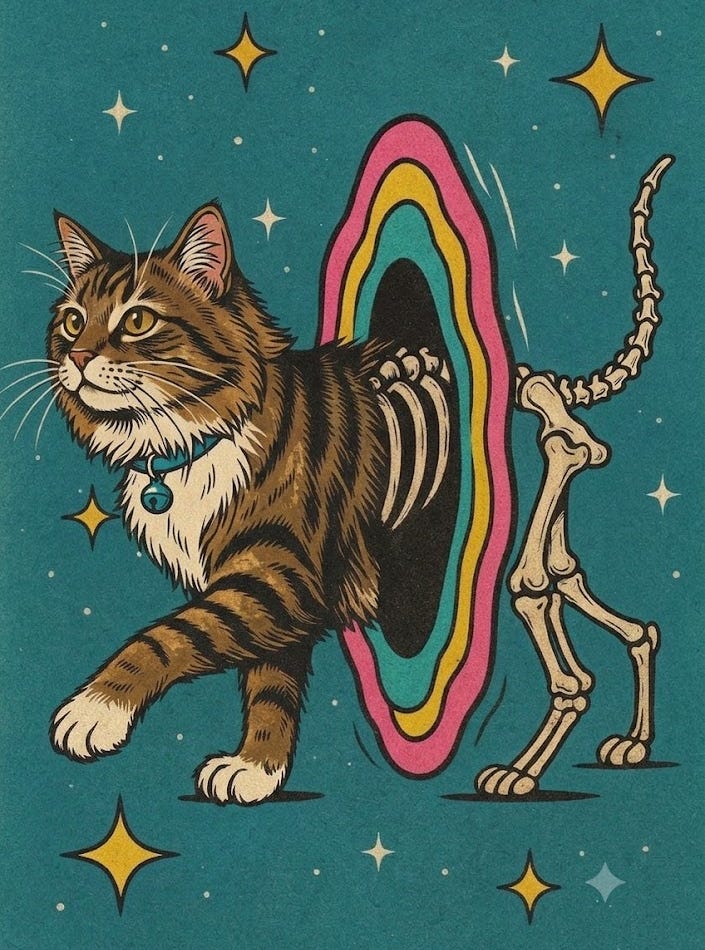
The cat came back wrong on a Tuesday, which I have always felt is the correct day for things to go wrong. Mondays are too obvious. By Tuesday you have your guard down. You think the bad part of the week is behind you and then your cat walks out of the airing cupboard with nothing but skeleton from the ribs back.
I should be clear about the airing cupboard. There was no portal in it that morning. I had put a load of towels in there the night before, the way a person does, and I had shut the door, the way a person does - following the storing of such items - and at no point did I think: this is where the membrane between worlds is thinnest. You don’t think that. You think about towels.
Rocky went in after the towels. He likes warm dark places and he is, or was, an enormous animal, and the airing cupboard is his preferred location for sulking, judging, and being a cat at me. I heard him go in around seven. I was making coffee. I heard the small thump of him settling. Ordinary morning.
At twenty past seven he came out.
The front half of him was exactly as it had always been. Half Maine Coon, half Siberian, fully magnificent and entirely aware of it — the great silver-brown mackerel coat, the lion’s ruff round the chest going soft and white, the tufted ears with their little Maine Coon flares, the absurd white socks. All of it correct. All of it Rocky, the cat built like an adult who has never for one day stopped being a kitten, fourteen pounds of fur and opinion looking at me down the length of his nose.
The back half of him was a skeleton.
Not a wound. Not an injury. There was no blood, no exposed meat or sinews, no horror-film business of it. The fur simply…stopped. It finished clean across his middle, just behind the ribs, the long luxurious coat ending in a neat line as though someone had drawn it there, and below the line, where the rest of that enormous fluffy animal should have been, there was a cat’s skeleton — clean and pale and articulated, the pelvis and the long delicate leg bones and the tail strung together vertebra by vertebra, the great plumed tail that was his best feature reduced to bare beads on a string. And it was walking, the bones moving in their sockets exactly as legs move, carrying the living front half of him across the landing toward me with the unhurried confidence of an animal that wants breakfast.
I want to record, for the sake of honesty, that I screamed. It was not a dignified sound. Kim was already at work or I would never have lived it down.
Rocky stopped at the top of the stairs and looked at me. The look said: you are being strange, and it is beneath you, and also where is the food.
I want to also record that he was purring.
Here is the thing nobody tells you about the impossible. You assume that if you saw something genuinely impossible - a thing that cannot be, a thing that breaks the rules you have organised your entire life around - you would do something large in response. Call someone. Run. Faint, perhaps, gracefully, into a chaise longue. You imagine yourself rising to the occasion of the supernatural.
You do not.
You stand at the top of your own stairs in a dressing gown holding a cooling coffee and you say, out loud, in the voice you use for the cat, “Rocky. Rocky, mate. Where are your trousers.” Because the front of him is all fur and glory and the back of him is bare bone, and that is genuinely what it looks like, a cat who has come downstairs in a smart jacket and forgotten the rest, and the part of my brain in charge of forming words went straight for trousers, and I stand by it. Some part of your brain has filed this under the cat has done something, the way it would file a knocked-over plant or a dead mouse on the doormat, and that part of your brain is in charge now because the rest of it has gone somewhere quiet and is sitting with its knees up.
So I followed him downstairs. What else does one do? The bones clicked very faintly on the steps, a sound like someone idly playing with a pen. Tick. Tick. Tick. He took the stairs the way he always did, a little sideways, and the skeleton did all the things the hindquarters used to do, and that was almost the worst part, that it was so competent.
In the kitchen he sat by his bowl. Half of him sat. The skeleton arranged itself into a sitting position, the pelvis tilting, the leg bones folding, and it should not have been able to do that without muscles or tendons or any of the load-bearing equipment of being alive, and it did it anyway, and then the tail - the bare strung vertebrae of the tail - curled neatly around the foot bones the way a cat’s tail does when a cat has decided to be patient with you, because after all, you are only a human.
I fed him. Obviously I fed him. He was hungry. You can hold two thoughts at once and one of mine was the membrane between worlds has opened in my airing cupboard and the other was he hasn’t eaten since six last night, poor lad, and the second thought won because it is the thought I have had every morning for eleven years and it knows the way.
I poured the kibble. He ate.
The kibble went in the front of him, which was a cat, and came out the back of him, which was not entirely a cat, and landed on the kitchen floor with a sound I will be hearing for the rest of my life. A light, dry, scattering patter. Like the first few seconds of rain. The biscuits dropped straight through the place where his stomach used to be and bounced off the bones of his hips and came to rest in a small neat pile between his back feet, and he kept eating, and more came through, and the pile grew, and he did not stop, and he did not notice, and he did not care.
He ate his whole breakfast. All of it went straight through him onto the lino.
Then he licked his lips, unhurried, thorough, the full performance of a cat who has enjoyed his breakfast, and he stepped over the pile of kibble that had been inside him ninety seconds ago, and he went to find a sunbeam.
I stood there for a long time.
Then I got the dustpan, because somebody had to, and that somebody was me, because it is always me.
I did not call anyone. I want to be honest about that too, because I think people imagine they would call someone and I think they are wrong about themselves the way I was wrong about myself.
Who would I call? Run the conversations.
The vet? “Hello, yes, my cat is half skeleton.” “Is he in distress?” “No, he’s asleep on the radiator.” “...Is he in distress, or are you?” And there’s no good answer to that, because the honest answer is me, it’s me, I’m the one in distress, the cat is having the best day of his life.
A friend? I’d have to send a photo and then they’d think I’d done something to him, or done something to a photo, and I am a person who writes horror for a living, so really I’d brought that suspicion on myself.
Kim? Kim was at work. Kim had a difficult day already; I knew this because Kim had told me at six that morning, eyes still shut, “today’s going to be a nightmare,” and I was not about to ring up and say funny you should mention nightmares. Some things you tell your partner in person. You tell them when they’re sitting down. You tell them after dinner, gently, the way you’d tell them the boiler had gone again, except the boiler is the cat and the cat is half bone and walking.
So I didn’t call anyone. I did what I actually do, which is I tried to work out the rules.
This is the writer’s disease and it does not switch off for the apocalypse. Something impossible happens and the part of me that builds stories for a living sits up and says: all right, but it’ll be consistent, it’ll have rules, find the rules. As though the universe owed me a coherent magic system. As though I could edit it.
Here is what I established that first day, between dustpans.
It did not hurt him. He ate, he slept, he sat in the window and chattered at a magpie, he came when I shook the treats. He was entirely, infuriatingly fine.
It was not contagious to the rest of him. The front half stayed front half. The line between cat and skeleton ran clean across his middle, just behind the ribs, and it did not move, and nothing leaked across it in either direction.
And it was not, I would learn, permanent. Because the next morning it was the other way round.
I came down on Wednesday and the back half of him was a cat again - the full glorious coat, the great plumed tail restored, the proper everything - and the front half was the skeleton.
The skull. That’s a different proposition, a cat’s skull walking toward you across the kitchen, the long fanged jaw and the great empty orbits where the eyes used to be, and behind it the whole front architecture of him laid bare and clicking, skull and spine and the cage of his ribs, all the way back to that same clean line just behind the ribs - and there the fur began, the long coat erupting out of bare bone mid-body, the lion’s ruff, the great plumed tail, the enormous fluffy hindquarters padding along quite happily behind the skeleton that led them. The contrast of it, the ordinariness of the back half, made the front half so much worse.
He still wanted breakfast. Of course he did. The skull had a jaw and the jaw still worked. He crunched the kibble with teeth that had nothing behind them, no tongue, no throat, and it fell straight down through the gap where his neck opened into nothing and landed - again - on the floor, tick tick patter, the morning rain.
I got the dustpan.
“You’ve swapped,” I told him.
The skull turned to look at me. There is no expression on a skull. I have a degree’s worth of opinions about how we project emotion onto things that have none, the pareidolia of grief, the way we make faces out of clouds and meaning out of static. I know all that. And I am telling you that the skull looked at me with enormous patience and a faint disappointment, as though I had said something obvious, as though of course he’d swapped, what did I expect, did I think the dead half would just stay put and be the dead half forever, how boring, how like me.
Then he went and sat in the sun, where the bones of his face caught the light and the bones of his face did not need the warmth and sat in it anyway, because that is what he had always done, and the habit had outlived the need for it.
That was when I understood that this was not an event. I had been treating it as an event - a thing that had happened, a thing with a before and an after, a thing I would one day be telling people about in the past tense. You’ll never guess what happened to Rocky.
It was not an event. It was a schedule.
He crossed every night.
I worked it out by the third day and confirmed it by the fifth: every night, sometime in the small hours, Rocky got up from wherever he was sleeping and he went to the airing cupboard, and he went in, and he came out the other side of something, and he traded. Whichever half had been bone became cat. Whichever half had been cat became bone. Clean swap. Every night. Like a shift worker. Like a man clocking on.
Only the first crossing ever happened in daylight. Seven in the morning, towels still warm, me in the kitchen. Every one since has been at twenty to four. I have thought about this more than is healthy and the best I have is that the first one was an accident - wrong cupboard, wrong cat, wrong Tuesday - and everything after it has been the keeping of an appointment that got made by mistake and is binding anyway.
I knew it was the airing cupboard because on the fourth night I stayed up to watch, sitting on the landing in the dark with a blanket and a torch I didn’t dare use, and at twenty to four he padded past me - front half skeleton that night, the skull bobbing along at ankle height - and he did not so much as glance at me. He nosed the airing cupboard door open the way he always had, the little headbutt and shove, and he went in among the towels.
I did not hear a thump. I did not hear anything. The cupboard was silent in a way that cupboards are not, a held silence, a silence with edges.
He was in there four minutes. I counted.
He came out whole.
All cat. Front and back, nose to tail, every inch of him fur and muscle and warm, and he stretched, the full luxurious downward-dog stretch, claws out, and he yawned, then he walked back to bed, and he was perfect.
For about a minute and a half I let myself believe it was over. That he’d worked through it, whatever it was, that he’d gone in broken one too many times and come out fixed, that the airing cupboard had finished with him.
Then, as he passed under the landing light, I saw it.
His shadow.
The light was above and behind him and his shadow fell long across the carpet ahead of him, and the cat was whole but the shadow was not. The shadow led with a skull. The bare jaw, the spine, the cage of the ribs thrown black and clicking across the floor, and behind it the soft mass of the plumed half - the arrangement he had walked in with, ten minutes and one crossing ago, as though the shadow hadn’t got the memo, as though somewhere the old version of him was still walking and this whole-bodied cat in front of me was the lie and the shadow was the truth.
He reached the bedroom door. The shadow reached it a moment later, dragging.
And just before he went in - I swear this, I will swear it to Kim and to the vet and to anyone, I swear it on the towels - just before he went in, the whole half of him that the light could not reach, the far side of him, the side turned away from me into the dark of the doorway, was cold. I felt it from six feet away. A draught coming off him. Off the dark side of a warm cat. A draught with nothing behind it, the breath of a held-edge silence, the smell of a place that is not a place, and it touched my face the way the air touches you at the mouth of a cave, the deep ones, the ones that go down, the ones where the air coming up has not been warm in a hundred thousand years and remembers things.
Then he was through the door, and gone, and the draught was gone. The night was just a night again.
In the morning he was split as usual, fur to the line behind the ribs, bone aft, business as normal, and the whole night might have been a dream except for the carpet outside the bedroom door, which stayed cold in that one stripe for three days.
That is the night I cannot make fit. He swaps. That is the rule, my one rule, the rule I built like a man bailing a boat with a teacup: every crossing trades the halves. It does not make him whole. It made him whole once, for one walk down one landing, and it has never done it since, and a rule that bends once is not a rule. It is a term in a negotiation I am not party to. Something let him out intact that night, the way you might let a thing you are keeping stretch its legs, and then it put him back on schedule, and I have decided not to think about what that means, and I think about nothing else.
It is six weeks now.
I have stopped using the dustpan after every meal. I sweep up twice a day, morning and evening, and I have got it down to a rhythm, and I no longer flinch at the patter of him eating. You’d be amazed what you stop flinching at. Kim knows. Kim took it better than I did, which tells you everything about which of us should be writing horror and which of us should be running the actual household. Kim looked at the half-skeleton cat purring on the windowsill on day one and said, “Well, he’s still eating,” and got on with her day, and she was right, and I love her, and I have never felt so thoroughly out-married in my life.
We have rules now. We do not open the airing cupboard at night. We let him go in. We do not follow. The towels are warm in the morning and we do not ask why the towels are warm when the radiator behind them has been off for weeks. We have agreed, Kim and I, without ever quite saying it, that the cupboard is his and the house is ours and the arrangement is fine. It is fine. He is happy. He is the happiest cat in England. He has solved death by simply taking turns at it and he could not be more relaxed about the whole business.
So it’s fine.
It’s just the shadow I can’t get past.
Because the shadow is always one day behind. I’ve checked, I’ve watched, I’ve sat on that landing more nights than I’ll admit. The cat is today and the shadow is yesterday, always, the split always one trade out of step, and I have started to wonder what that means. What it means that there’s a version of him a day behind, walking the same routes a beat too late, dragging the old arrangement across the carpet.
I have started to wonder how far behind a thing can fall before it stops being behind you and starts being somewhere else entirely. Coming the other way.
And last night — this is the part I haven’t told Kim, this is the part I’m telling you because you’re not sitting in my house in the dark — last night he went into the cupboard at twenty to four as he always does, front half bone, the skull bobbing, and he was in there four minutes as he always is, and I counted, and I sat with my blanket and my torch I never use.
And at four minutes I heard the thump of him settling among the towels.
And at four minutes and ten seconds I heard a second thump.
Smaller. Further in. From the back of a cupboard that does not have a back.
And then the patter started. The light, dry, scattering patter, the first few seconds of rain, the sound of something eating, the sound of something falling straight through the place where a stomach should be. Except the cat had not come out yet, the cat was still in there, and I had not put any food down.
I did not open the cupboard.
I have not opened it today.
It’s nearly twenty to four.
This is just brilliant! I loved every word. It laughed, smiled, and saw the images with vivid clarity.
Thank you so so much for brightening my day!
🖤🖤🖤
Creepy... also, poor Rocky.