
The Siege
The Good Folk: Part Three

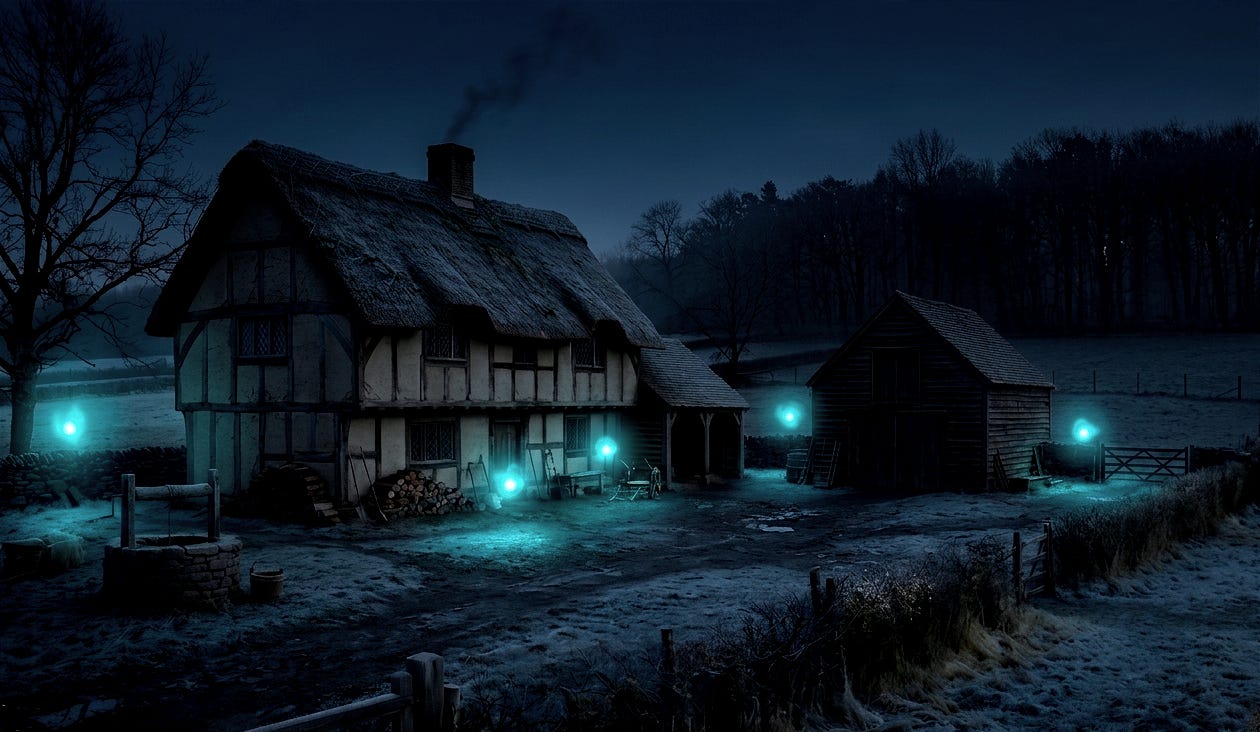
The lights crossed the lower field in a line.
Will watched them through the sliver in the shutter, his hand on the nail, his breath held without his choosing. They moved across the frost in formation, evenly spaced, the same height from the ground, the same pale blue steady light with no flicker and no source. His father had described soldiers crossing a field in the war, steady and measured, each one holding his distance from the next. Edmund had told him those stories by the fire in winter. Will had listened the way a boy listens to things that belong to a world he will never see. He was seeing it now.
Edmund’s voice had not stopped. The Scripture moved through the room, familiar words in a familiar cadence, and Will held to the sound of it. Behind him Bess was quiet. He kept his eyes on the shutter. He was afraid of what he would see if he turned.
The lights stopped at the yard fence.
All of them, at once, as though a single decision had been made. They hung there in a line along the boundary of the yard, pale and patient, perhaps thirty paces from the house. Will could feel them. A pressure against the front of his skull. A warmth in the air that had no right to be warm. The hum that had begun beneath music was louder now, louder behind his eyes, pressing.
Edmund stopped reading.
The silence after his voice was worse than any sound. He closed the Bible and set it on the table and stood very still, his head slightly turned, listening. Will saw his father’s hands, flat on the wooden surface, the fingers spread, and he understood that his father was feeling it too. The hum. The pressure. The weight pushing against the walls of the house.
“Alice,” Edmund said quietly.
She was already moving. She crossed from the fire to the pallet where Bess had been sitting, and Will heard her breath catch, a small sound, the sound a person makes when they find what they expected to find and had prayed against.
Bess was asleep.
She lay on the pallet with her hands open at her sides, palms upward, the same posture she had held in the ring that morning. Her face was peaceful. Her breathing was deep and even and slow, too slow. A child of six who falls asleep by a fire sleeps with her knees up and her thumb in her mouth and her body curled toward the warmth. Bess lay straight and still and open. Arranged.
Alice knelt beside her. She put her hand on Bess’s forehead, then her cheek, then took the child’s wrist between her fingers as her mother had taught her. She held it for a long time. When she looked up at Edmund her face held what Edmund read as relief, because relief was what he needed to see, because Bess was breathing and warm and that had to be enough.
Will saw it differently. Standing at his post, watching his mother’s face across the room in the firelight. Alice had gone still. The stillness of a woman whose worst fear has already happened and what remains is only the knowing of it. She was looking at her daughter and Will understood that she had already lost her, somewhere between the ring and the pallet, in a way none of them had seen.
She tucked the blanket around Bess. She smoothed the child’s hair back from her forehead with a tenderness that was careful, precise. The tenderness of a woman touching what she is memorising.
“She will not awaken,” Alice said. “The music holds her.”
“What music?” Edmund said.
Alice looked at him. “You cannot hear it?”
Edmund’s jaw worked. The same working when he was being told something that lived outside the shape of what he believed. He looked at Will.
“Can you hear music?”
Will listened. The hum was there, the pressure, the weight behind his eyes. Beneath it, or within it, something else. A pattern. A structure, repeating. He had not called it music until his mother said the word. Now that she had said it he could hear nothing else.
“Yes,” he said.
Edmund looked at his son, then at his wife, then at the shutter where the light from outside pressed against the salt-soaked rags in the gaps. His hand returned to the Bible. He opened it and began to read again, louder now, the words filling the room, a man trying to push something out of it, trying to leave no space for the press from outside.
Will turned back to his post. The lights at the yard fence had not moved.
The music beneath the hum grew. It did not grow louder. It grew closer, a melody that had always been present and was only now allowing itself to be noticed. Will felt it in his hands, in the soles of his feet against the stone floor, in the bones of his jaw. It was patient. It had been patient for longer than Will could think about, longer than the farm, longer than the wood. It was willing to wait because time was something it understood differently than the family huddled around their iron and their fire.
On the pallet, Bess slept and did not move.
The first pressure came at the door.
A knock would have been familiar, something the house knew how to receive, and Edmund could have gone to the door and asked who was there in the voice he used for asking. This was different. A slow weight settling against the timber from the outside. A force without urgency, present and patient and increasing. The door creaked in its frame. The iron bar Edmund had set across it that afternoon shifted half an inch in its brackets and was still.
Edmund moved.
He crossed the room in two strides and put his shoulder against the door, set his feet, drove his weight into the wood. Will watched his father do it and saw something else at the same time, something he would carry for the rest of his life. The relief in Edmund’s face. The relief of a man who had been waiting for the war to begin, who had been holding himself ready for hours against an enemy he could not see, and who at last had something to push back against. Edmund braced the door, his face went hard, his breath came steady. He was a soldier again. Not for Lords, not for country. For his family.
The pressure held. A weight against the door that matched Edmund’s against it from the inside, the two of them measured against each other through three inches of oak.
Alice was at the hearth. She had moved without Edmund telling her to move, and she was doing things with her hands that Will could not see clearly from his post, things at the salt-line she had laid that afternoon along the threshold. Her lips were moving. The words were not English. Will did not know what they were. He understood that his mother had grown up in a house where these words were spoken and had carried them inside her for forty years without speaking them, and was speaking them now because the time for not speaking them was past.
Edmund did not look at her. Edmund was at the door and the door was his.
Will turned back to his shutter.
The lights at the yard fence had moved. Not all of them. Three remained where they had been, hanging at the line of the boundary, pale and steady. The other three had separated. One was at the side of the house. One was at the back. The third was somewhere Will could not see, and the not seeing of it was worse than the seeing of the other two, because it meant the third was somewhere it had decided to be and Will did not know where.
He pressed his eye closer to the sliver.
The light at the side of the house was nearer than any of them had been, perhaps ten feet from the wall. He could see it more clearly now. Could see that it did not come from anything. There was no lantern, no torch, no shape behind it that held it up. The light was simply there, hanging in the cold air at the height of a man’s head, pale and steady and patient. He looked into it and felt his eyes pull, the way eyes pull toward fire, and he made himself look away.
When he looked back the light was at the shutter.
It had not moved that he had seen. It was there, six feet from his face, a foot from the boards of the wall, and the salt-soaked rags in the gaps of the shutter were glowing faintly with the colour of it.
Then the voice came.
Not through the shutter. Not through the wood. Inside his head, where his own voice was, where the voice he heard when he read silently to himself was. A voice that knew his name. A voice that said his name once, very softly, the way his mother said it when she wanted him to come and look at something she had found in the garden. Gentle. Unhurried. Certain that he would come because he had always come.
Will.
He did not move. He did not breathe. The voice did not say his name a second time. It did not need to. The first time was enough, was more than enough, was the whole of what it needed to do, because Will had heard his own name spoken in the place where he heard his own thoughts, and he understood that the speaker outside the shutter could go there, and that there was nowhere in him that was safe.
Will, the voice said again. Open the shutter.
His hand was on the iron nail. It was cold under his palm. He held to the cold of it the way a man holds to anything that will not leave him.
Open the shutter, Will. We have something to show you.
The voice was very kind. That was the worst of it. Will had thought, without ever thinking it, that the things in the wood would be cruel. That they would speak to him with the voices of cruelty and that knowing this would make them easier to refuse. The voice was not cruel. The voice was patient and warm and interested in him, in him specifically, in Will who had no friends his own age within a day’s walk and who had been alone in his head for a long time. The voice knew this. The voice was offering itself, not threatening, offering, the way a person offers itself to a boy who has been alone.
Will. Open the shutter.
He gripped the nail. The cold came up his arm and he held to it.
He thought, with effort, of his father at the door. Of his father’s shoulder against the wood. Of his father’s breath coming steady. Of the look on his father’s face, the soldier’s face, the relief of having something to push against.
Hold the position. You do not leave your post. You do not open the shutter.
He thought it back at the voice. He did not know if the voice could hear him think. He thought it anyway.
The voice did not say his name again. Whether it had heard him, whether it had simply moved on to other windows, other shutters, other boys it was patiently and warmly inviting, Will did not know. The light at his shutter remained. The pressure behind his eyes remained. But the voice was quiet, and the quiet of it was worse than the speaking of it, because the quiet meant the voice was waiting.
It was very willing to wait.
Will pressed his forehead against the cold wood of the shutter, held the nail, did not open it.
Behind him, his father’s shoulder was still against the door. His mother’s lips were still moving in the words she had carried for forty years. The pressure against the threshold was steady, neither growing nor easing, the patient weight of an enemy that had all night.
On the pallet, Bess slept and did not move.
The pressure eased.
Will felt it before his father did. The weight at his shutter lifted, the light at the wall pulled back, the voice in his head went still in a way that meant the speaker had withdrawn, not gone. The hum was still present, the music still beneath it, but the press of it had changed. The presence outside was listening now instead of pushing.
Edmund felt it a moment later. The door under his shoulder gave back the lost weight in increments. He kept his shoulder there for a long time after the pressure was gone, distrusting it, the soldier’s habit of suspecting the lull. When at last he stepped back from the door he was breathing hard, and his shirt was dark down the back with sweat despite the cold of the room.
He looked at Will. Will nodded once, a small nod, the most a boy could give without leaving his post.
“It is not over,” Alice said.
She was at the threshold. She had been there for some time, Will understood now, working at the line of salt she had laid that afternoon, her lips moving in the words from her mother’s house. There was a small wooden bowl in her hand. Will had not seen her bring it from the shelf. The bowl was full of milk.
She knelt at the door, set the bowl on the stone of the threshold, on the inside of the iron, and spoke a sentence Will did not understand. Then she stood and stepped back from the door. The bowl remained, white in the firelight, three feet from where the pressure had been.
Edmund saw it.
Will watched his father’s face go through three things in the time it took to draw a breath. The first was confusion, brief. The second was understanding. The third was a fury that Will had never seen in his father’s face, not in sixteen years, and the seeing of it frightened him in a way the voice at the shutter had not. His father’s anger was the anger of a man whose ground had moved beneath him.
“Take it up,” Edmund said.
Alice did not move.
“Alice. Take it up. We do not feed them at our threshold. We do not feed them anywhere. You will take it up.”
“It is working,” Alice said quietly.
“What is working?”
“They have stepped back. The pressure is gone. The bowl is the reason.”
“The bowl is heathen practice. The bowl is what your grandmothers did when they did not have the Word. You have the Word, Alice. We have the Word. We do not feed the Devil milk.”
“I am not feeding the Devil,” Alice said. Her voice had gone steady in a way that was harder than Edmund’s anger. “I am keeping our daughter.”
Edmund stepped toward her. He did not raise his hand. He had never raised his hand in the house in his life. He stepped toward her and stopped, and the stopping was a discipline that took him visible effort. Will watched his father’s hands close into fists at his sides and open again.
“They have already had her, Edmund. This morning. They had her in the ring and she went willingly and she does not remember how. The iron at the door is good. The prayer is good. The bowl is what my mother taught me and her mother taught her and it has kept children in this country longer than before your Bible came to our shores. I will not take it up.”
“You will take it up.”
“I will not.”
Will stood at his shutter. He did not turn. He did not want to see his parents looking at each other across the floor of the house in which he had been born. The voice in his head was still gone, the lights at the yard fence were still where they had been, and the presence outside was listening. Will understood with a cold certainty that it was listening to this.
“They feed on it, Alice. Whatever the bowl is, whatever you think the bowl is doing, they take it as tribute. They take it as our bowing. We have bowed and they will return for what is bowed to.”
“They returned anyway.”
“You do not know that.”
“I know it because my mother knew it and her mother knew it before her. The bowl is the price. The bowl is the small thing you give so that the larger thing is not taken. You have been a soldier, Edmund. You know what tribute is. You know there are positions you cannot hold without it.”
“I held positions in the war without paying tribute to the Devil.”
“You held them,” Alice said, “and many men died around you who were not paying the tribute you think they were not paying. Do not tell me about war. I sat in this house for two years not knowing if you were alive. I learned my own war. The war I learned was the one my mother taught me and I will fight it the way I was taught.”
Edmund said nothing for a long time.
The fire moved in the hearth. The hum was steady. On the pallet, Bess had not shifted. Her breathing was the same slow measured breathing it had been since the music began.
“If the bowl is on the threshold in the morning,” Edmund said, “I will throw it out. With the milk. Both. I will not have it in my house at first light.”
“That is your choice in the morning,” Alice said. “Tonight the bowl stays.”
Edmund looked at her. Something passed between them that Will could not read, a knowing seventeen years long. Then Edmund turned and went back to the door, put his hand flat against the wood, stood there with his head bowed. Will did not know if he was praying or listening or simply standing because he could not yet do anything else.
Alice came to the pallet and sat beside Bess with her hands in her lap and watched her daughter sleep, and after a long time Will saw that her face was wet. She made no sound. The tears went down her face. She did not wipe them. She did not look away from Bess. Will understood, watching her, that his mother was sitting with Bess the way you sit with the dying. Not because Bess was dying. Because his mother knew something he did not know, something Edmund did not know, something the bowl at the threshold was a small last delay against.
The pressure did not return for a long time.
The lights at the fence remained. The hum remained, lower now, the music beneath it still patient and still close. Will stood at his shutter with his hand on the cold of the iron nail and watched the dark and listened to the quiet of his parents who were not speaking and the slow breath of his sister who would not wake.
The milk in the bowl at the threshold went undisturbed. The presence that had wanted to come through the door waited. The night was very long.
Will did not know how long the lull held.
Time had gone strange in the house. The fire burned low and Edmund put more wood on it and the wood burned and the fire was low again, and Will could not have said whether an hour had passed or three. The hum was constant, as was the music beneath it. Outside, the lights at the fence held their line, the one at his shutter had not returned, the voice in his head had not spoken his name again. He did not know whether this was a mercy or a strategy.
He stood at his post. His legs were shaking from the cold and from the standing. He did not sit down. His father was at the door. His mother was at the pallet. Will held his shutter because that was what he had been told to hold and because letting go of it was a possibility he could not let himself imagine.
It was the smallest sound that turned him.
A breath. Not Bess’s slow measured breathing, not the rhythm of the music holding her down. A short breath, the kind a person takes when they are about to speak.
Will turned from the shutter.
Bess was sitting up.
She was on the pallet with the blanket pushed back and her bare feet on the floor. She was sitting straight, her hands flat at her sides on the pallet, her head tilted slightly. Her eyes were open.
She was looking at his shutter.
Her head was tilted toward the gap. Toward the sliver. Toward the place where the salt-soaked rags had let the light through.
Will did not call out.
His mother was at the hearth with her back to the room. His father was at the door with his head bowed against the wood. Neither of them had turned. Bess sitting up on the pallet, the blanket pushed back, her bare feet on the floor, was happening in a corner of the room neither of them was watching. Will understood, without being able to say why, that they would not turn until he made them turn. The music had taken that from them for as long as it needed.
He did not know why he did not call out, then or later. He did not call to his mother, nor to his father, did not raise the alarm. He moved. He left his post for the first time since dusk and crossed the floor of the house in four steps, soft, his boots making no sound on the stone. He reached his sister and went down on his knees in front of her so that his face was between hers and the shutter and his shoulders blocked her view of the gap.
“Bess,” he said.
She did not see him.
She was looking through him. Her eyes were on the place where the shutter had been when his shoulders had not been in the way, her face had not changed, the small breath she had taken was still inside her, held, waiting.
“Bess. Look at me.”
He put his hands on her shoulders. She was warm. She was warmer than she had been in his arms that morning at the ring, warmer than a child should be in October in a stone house at the dead hour of the night. The warmth came up through her nightdress into his palms.
“Bess. It is Will. Look at me.”
Her eyes shifted. Slowly, the way her eyes had shifted in the ring when he had knelt in front of her and said her name three times. Travelling back from a great distance. He watched them come, watched the slow journey of his sister’s awareness back into her own face, and when at last her eyes found his he held to them with everything he had.
She blinked.
“Will,” she said.
Her voice was her own. The small bright voice that had told him secrets in the upper field in summer. The voice that had asked him questions about why the sky was blue and where the stars went in the day. The voice of his sister. It was Bess. He had her. He had reached her in time.
“I am here,” he said. “I am here, Bess. You are safe. Look at me. Stay with me.”
“I had a dream,” she said.
“Yes.”
“There was music.”
“I know.”
“They wanted me to come and listen. Closer. They said I could come closer.”
“You did not have to go,” Will said. His voice was shaking. He held to her shoulders and felt her warm and present under his hands, his sister, returned. “You do not have to go. You stay here with me. You stay with us.”
She looked at him. Her face was open and small and tired, the face of a child woken in the night. She lifted one hand from the pallet and put it against his cheek, the way she did sometimes when she wanted his attention, the small flat warm hand of a six-year-old.
“Will,” she said.
“Yes.”
She looked at him very seriously. The hand on his cheek did not move.
“What if I want to?”
He did not understand the question. Not at first. His mind heard the words and did not place them, and when his mind placed them, the cold went through him in a way nothing in the night had yet made him cold. He looked at her face. The face was Bess. The eyes were Bess. The small hand on his cheek was Bess. The question was not Bess.
“You do not want to,” he said. “Bess. You do not want to. You want to stay here. With me. With Mother. With Father.”
She looked at him for a long moment. Her hand stayed against his cheek. He thought he saw something move behind her eyes, some small deciding.
Then she smiled. The smile was tired and small and she was six years old and her brother was kneeling in front of her and she nodded.
“Yes,” she said. “I want to stay with you.”
She put her arms around his neck. He gathered her up off the pallet and held her against him. She was warm. She was breathing. Her face went into the hollow of his neck the way it had gone a thousand times before.
“I am here,” he said into her hair. “I have you. I have you, Bess. I am here.”
She did not answer. After a moment her breathing slowed and steadied and went deep, and he understood that she had fallen asleep against him, the ordinary asleep of a tired child held by her brother. He felt her go heavy in his arms, her small body trusting his. His eyes filled and he held her tighter.
He had reached her in time.
He stood with her in his arms and went back to his post by the shutter, because he could not put her down, because she was warm and she was his sister and he would hold her until the morning came. He stood with his back to the shutter and Bess against his chest and her face in his neck. He watched his mother across the room build up the fire, his father hold the door, the night going on around them.
He did not turn back to the gap in the shutter.
If he had turned, he would have seen that the light had returned, that it was very close now, closer than it had been all night, hanging at the salt-soaked rags. He would have seen that the rags were brighter than they had been before, lit from outside with the pale steady colour of what had wanted in.
He did not turn. He held his sister. He believed he had reached her in time. He did not see the light at the shutter. He did not see, because he could not have seen, the small deciding that had passed in the moment between her question and her smile. The moment he had looked into her eyes and pleaded with her and she had decided.
He held her. She slept against him, warm and small and breathing.
He had her.
The pressure returned all at once.
Not only at the door. At everything. The shutter behind Will, the door at his father’s shoulder, the back wall, the loft above them, the stone of the hearth. Every surface of the house was pressed at the same instant, and the house answered in a long low sound that was not the sound of a building. The sound of a structure under a weight it had not been built to bear.
Will felt it through Bess. She was still asleep against his chest, the ordinary asleep of the held child, and the pressure went through her too. He felt her small body tense, then go limp again. He understood that the music had her once more, deeper now, that the brief return of his sister to herself was over and the presence that had decided her had taken its decision back.
Edmund braced.
He drove his shoulder against the door, his other hand came up flat against the wood beside it, his head went down between his shoulders. The Bible was on the table behind him, closed. He had no breath for Scripture now. The breath he had was for keeping his feet under him and his shoulder against the timber.
The door shifted.
Half an inch, no more. The iron bar in its brackets shifted with it. Edmund made a sound that was not a word, a grunt, the sound of a man taking a weight he had not known the size of. He pushed back. The door held. The bar held. The pressure did not ease.
“Alice,” he said, his voice almost gone with the effort.
She was already moving. She had a handful of something from the hearth, dried leaves, twigs that had been bound with red thread. She was at the door behind him pressing them to the wood at the height of the iron bar. Her lips moved in the words from her mother’s house. She worked fast, her hands sure, the long memory of women who had not needed to be told what to do. She put the bound twigs at three points on the door, then she was at the windows, then at the back of the house, then at the stone of the hearth, laying her things and speaking her words and not stopping.
The shutters.
Will turned. Bess in his arms, asleep, heavy. He turned and saw that his shutter, his post, the place he had left to go to his sister, was glowing. The salt-soaked rags in the gaps were lit from outside, the light pale and steady and so close that Will could feel it through the wood. The shutter was not breached. The iron nails were holding. The light was at it the way the pressure was at the door. Pressing. Patient. Willing the boards to give.
He had left his post.
The thought went through him cold and sharp. He had left his post and gone to Bess, and the shutter had not been watched for the time he had taken to reach her, and he could not now know what had come through the gap in those minutes. He looked at his sister in his arms. Her face was in his neck. She was warm. She was breathing. He had her.
“Will.”
His mother. She was at his shoulder. She had crossed the room without his seeing her cross it, her face very close to his, her eyes on Bess, questioning.
“Take her to the back wall. Sit against the stone. Put your hand over her ear, the ear that is not against your chest. Do not let go of her. Do not let go of her, Will.”
He did what she said. He carried Bess to the back of the house, the wall furthest from the door, and slid down with his back against the cold stone and his sister gathered into his lap. He put his right hand flat over her left ear, the ear that faced the room, and pressed her right ear against his chest where his heart was. She did not stir. She lay against him heavy and warm and the music was in her. He held her and pressed her ear to the place where his heart was beating. His heart was the only thing he had to give her.
His mother went to the door.
She stood beside Edmund, who was still bracing, his face the colour of a man who had spent everything he had and was finding more from a place he had not known about. She put her hand flat on the wood beside his hand. She spoke a long sentence in the words her mother had taught her, and another, and another. Her voice was steady. Will could see her lips moving. He could not hear the words over the hum.
The hum was not a hum any longer. It was a sound now, a sound that filled the house, that filled the inside of Will’s head and pressed against the inside of his eyes. The music was inside the sound. The music was clear, audible, and had finally come into the room. It was not a melody. It was a structure repeating, beautiful, patient, calling. He pressed Bess’s ear harder against his chest. He pressed his own free ear against the top of her head. He could not close it out. The music was inside his bones.
The door shifted again.
A full inch this time. Edmund roared. It was a sound Will had never heard from his father, a sound that came from a place his father did not show to his family, the sound of the soldier under the pike line at nineteen years old. He drove his shoulder into the door. The door went back into its frame. The iron bar held. Edmund’s prayer broke out of him in language Will did not know his father owned, half Scripture and half something rawer, a man speaking directly to God with no formality left in him.
“Lord. Lord of Hosts. Lord who delivered Daniel from the lions and the three from the furnace. Lord. Hold this door. Hold this door. Hold this door.”
Alice’s words moved beneath his. The two voices weaving. His loud, hers low. His English, hers older. Both of them at the same door. Both of them holding.
The shutter behind Will was glowing brighter. He did not turn to look at it. He held Bess and pressed her ear and watched his parents at the door across the room.
Outside, the dog began to scream.
It was a sound Will had never heard a dog make. He did not know a dog could make it. The dog had been silent since the calf in the loft, had sat in the yard and not gone into the barn and not come into the house, and had not made a sound through the long evening. Now it was screaming, the scream of a creature that has seen what it cannot bear to see. The scream went on and on. Then it stopped.
It did not trail off. It stopped.
Will closed his eyes.
In the barn the calf was silent. Will knew this without being told. The calf that had stood in the loft facing the wall had not made a sound through the night and would not make a sound again. The cattle were silent. The sheep in the lower field that had not been buried, the one that had simply stopped, was silent the way that ewe had been silent. All of it was silent now. The only sounds in the world were the music and his father’s voice and his mother’s voice and the long low sound of the house under the weight.
The pressure peaked.
Will felt it. The inside of his head was a single bright pressure, the music so loud it had stopped being music and become something else, a force that wanted only to be answered, to be opened to, to be let through. He held his sister. He pressed her ear to his heart. He did not open his eyes.
He thought, very clearly, of his sister’s face when she had asked him the question. What if I want to.
He thought, very clearly, no.
He did not know if he was thinking it at the music or at her or at himself. He thought it. He held it. He pressed Bess to his chest and held the no in his mind the way his father was holding the door. His father held the door. His mother spoke her words. The house held. The night went on.
Then the light changed.
He knew it before he opened his eyes. The pressure shifted, did not lift, shifted, the way a weight shifts when the body carrying it adjusts its grip. He opened his eyes. The shutters along the front of the house had a different colour at their edges. The light that had been pale blue and steady was thinner now, and behind it, at the gaps, there was grey.
The grey of morning.
Edmund saw it. Will watched his father’s face turn toward the front shutter and watched him see the grey, watched the seeing of it go through him, watched his father do something Will had never expected him to do. Edmund laughed. One short hard sound, half a sob, the laugh of a man who has been holding a position through the night and has heard the relief come up the road.
The pressure on the door eased.
Not all at once. In stages. The weight Edmund had been holding against gave back to him in degrees, and Edmund did not let his shoulder off the wood, did not trust it, kept his weight there as the pressure withdrew. Alice did not stop her words. She kept speaking them through the easing, low and steady, until the pressure was gone and the door under Edmund’s shoulder was only a door again.
The music thinned.
It did not stop. It went away the way a tide goes away, in slow withdrawal, the structure of it pulling back from the room, pulling back from inside Will’s head, pulling back from inside Bess in his arms. He felt her body change as the music left her. The strange held stillness went out of her and she was a sleeping child again, ordinary heavy, her breath warm against his neck.
The grey at the shutters became grey light.
The lights at the yard fence were gone. Will did not see them go. He knew they were gone because the colour at the shutters was only grey now, only morning, the cold thin light of October dawn against the eastern wall of the house.
Edmund stepped back from the door.
He stood in the middle of the room with his hands at his sides. His shirt was wet through. His hair was wet at the temples. He was breathing in long slow breaths, the breathing of a man who has been holding his breath for hours without knowing it. He looked at the door. He looked at the shutters. He looked at his wife, who was at his side, her hand still on the wood beside where his hand had been. He looked at Will against the back wall with Bess in his lap.
“It is morning,” Edmund said.
His voice was hoarse. Will had not heard his father’s voice that hoarse before.
Alice did not speak. She was looking at Bess in Will’s arms. Will looked down at his sister. She was asleep against him, warm, breathing, the ordinary breathing of a tired child. Her hair was against his cheek. Her small hand was loose in the front of his shirt. She had slept through the end of it. Slept through the lifting of the music. Slept through the dawn coming. She was sleeping deeper now.
Will looked up at his mother. Alice’s face was very still. She did not look like a woman who had won.
Will did not see this. He saw his sister in his arms, warm and breathing. He saw the grey light at the shutters. He heard his father’s voice, hoarse and present and his father’s. He felt the wall of stone behind him cold against his back.
He thought, with everything he had: we held.
He thought: I got to her in time.
He held his sister against his chest and the morning came in at the shutters and the house was very quiet.

Love these:
"The relief of a man who had been waiting for the war to begin, who had been holding himself ready for hours against an enemy he could not see, and who at last had something to push back against."
"Do not tell me about war. I sat in this house for two years not knowing if you were alive. I learned my own war."
"He had left his post."
The contrasting perspectives of Alice and Edmund, leaving Will to navigate the gravity between them, is all wonderful (to me). Very cool and looking forward to what happens next!