
The Good Folk
Part One: The Souring

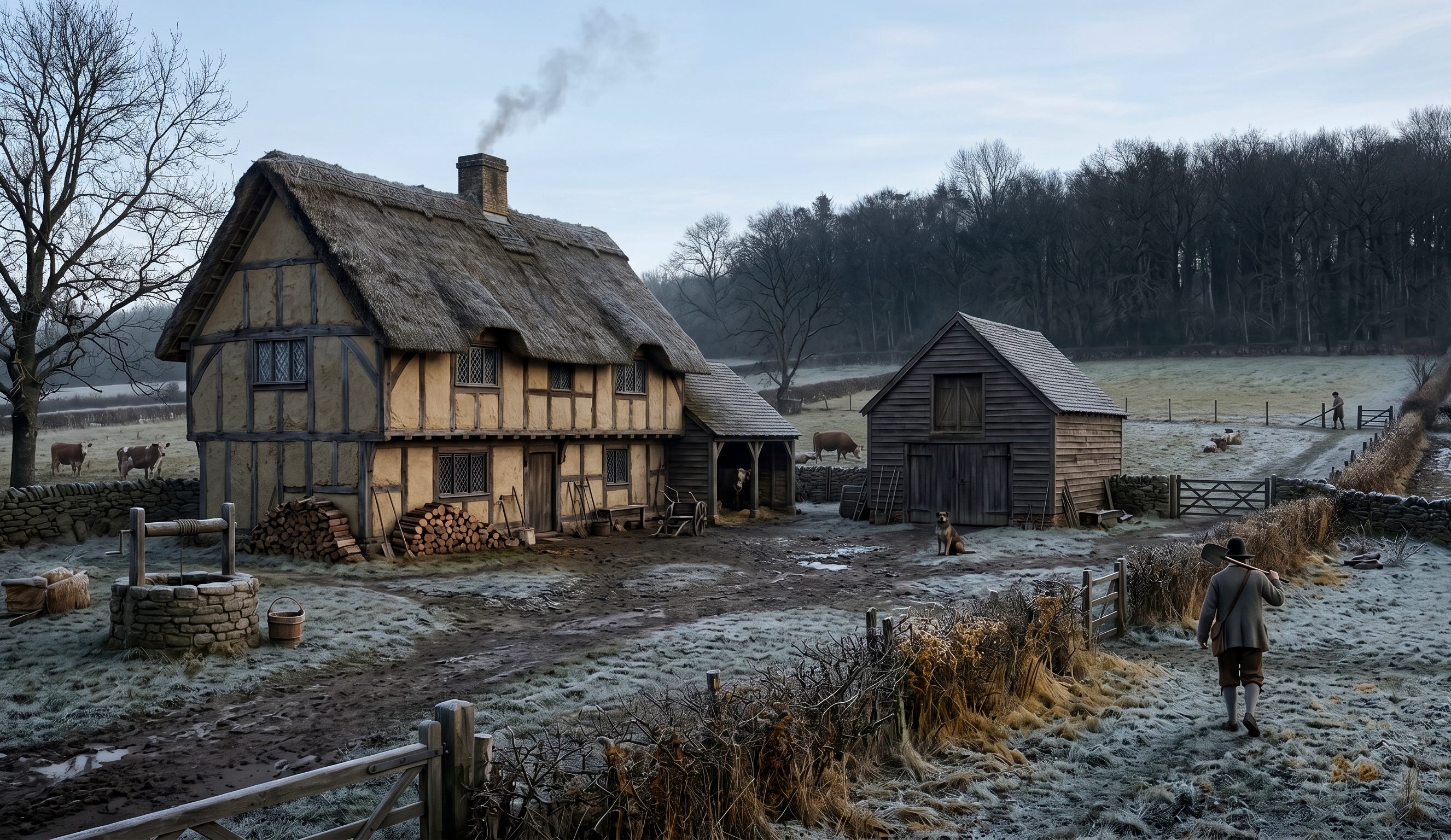
The cows came in easy that morning, which was the last morning Edmund Hartley would think of as ordinary for the rest of his life, though he did not know it then. He knew only the cold of the yard, the pale sky above the treeline, the familiar weight of the wooden pail as he crossed from byre to well and back again. October had come in hard that year. The ground underfoot was iron.
Alice had the fire built up by the time he came inside, the smell of it reaching him across the yard before he lifted the latch. She was at the pot, her back to him, speaking to Bess in the low steady way she had, as though the child were a skittish animal requiring quiet. Bess was not skittish. She sat on the hearthstone with her knees pulled up, her eyes very wide, listening to something Edmund could not hear. He hung his coat and said nothing. The mornings had their own order and he trusted it.
Will was already in the upper field. Edmund could see him from the window, moving along the fence line, checking the posts the way Edmund had shown him. The boy was sixteen and learning to work without being told, which was the beginning of a man. Edmund watched him for a moment, then looked away.
The sheep was in the lower field, hard against the boundary hedge, and Edmund found her on his second round of the morning. She lay on her side with her legs straight, the way an animal lies when death has come quickly, or when something has set it down. He stood over her for a time, the frost on the grass unbroken around her. No fox had been here. No dog. The hedge was intact, the ground undisturbed, the sheep lying in the pale October light as though she had simply stopped.
He looked at the treeline.
The wood ran along the eastern boundary of his land, close enough that in summer the shade of it reached the field by midmorning. He had always found it unremarkable. A wood was a wood. He had seen things in the war that had burned away whatever capacity for unease the natural world might once have provoked in him, or so he had believed. He looked at the treeline now and felt something he had no name for, something that lived below the register of thought. He held it there for a moment before he put it away.
He buried her himself, in the corner of the field where the hedge met the old stone wall. The ground was hard and the work took time. Will called to him from the upper field at one point, a question about the fence posts, and Edmund called back that it was nothing, a ewe gone in the night. Will accepted this and returned to his work.
Edmund did not tell Alice.
He was not certain why. They had kept nothing from each other in seventeen years of marriage, or nothing that mattered. He turned the question over as he walked back to the farm, the spade on his shoulder, the cold coming in off the wood. He had no answer that satisfied him. Only the feeling that to speak it would be to make it into something, and he was not ready for it to be something yet.
Will found the marks in the afternoon.
He had gone back to the lower field to finish the fence line, working his way along the boundary toward the eastern corner where his father had been digging that morning. The turned earth was still dark against the frost. He did not look at it long.
The marks were in the mud along the treeline, following the boundary for perhaps twenty yards before they stopped. He crouched over them in the thin afternoon light, turning them over in his mind the way his father had taught him to read ground. Not fox. Not deer. The spacing was wrong, the depth was wrong, and there was a quality to them he could not name, a regularity that did not belong to any animal he knew. They came from the wood. They stopped at the boundary. They did not go back.
He stood up and looked into the trees.
The wood was still in the way that woods are still in October, the leaves mostly down, the light coming through grey and flat. Nothing moved. Will was not a boy given to fancies. His father had seen to that, quietly and consistently, over sixteen years. He believed in what he could put his hands on. He looked at the marks, looked at the wood, and felt the short hairs rise on the back of his neck the way they did sometimes in the moment before a storm broke.
He finished the fence line and said nothing at supper.
He was his father’s son.
Edmund saw the cow from the yard as the light failed.
She was at the far fence, the one that ran along the eastern boundary, standing with her head raised, her body perfectly still. He watched her from across the yard for a time, his breath clouding in the cold. The other cattle had come in at dusk as they always did, filing through the byre door in their patient order. This one had not come. He had not noticed until now, and the not noticing sat uneasily with him. He was a man who noticed.
He crossed the yard and took the fence line toward her, the lantern throwing his shadow long behind him. She did not turn at his approach. Did not shift or low or show any sign that she heard him coming through the frost-stiff grass. He came up beside her, put his hand on her flank. She was warm, breathing, present, wholly elsewhere. Her eyes were open, fixed on the treeline. He followed her gaze and saw nothing. The wood was dark. The wood was simply dark.
He stood with her for a time, his hand on her flank, the lantern light reaching a little way into the trees and finding nothing.
Then he took her halter and led her in. She came without resistance, walking beside him like a thing being returned from somewhere it had gone willingly. He bolted the byre door and checked it twice. He did not examine why he checked it twice.
Inside, Alice had the children at supper. Bess was telling Will something in the serious confiding way she had, her small hands moving, and Will was listening with his eyes on his bowl, the ghost of a smile on his face. Alice looked up when Edmund came in, read something in him the way she always could. He shook his head slightly. She looked at him a moment longer before she turned back to the pot.
After supper Edmund read from Scripture. He did this every evening, a chapter, sometimes two, his voice steady in the firelit room. Bess fell asleep against Will’s arm before he reached the end, her breathing slow and even, her face open and untroubled. Will carried her up without being asked.
Edmund sat by the fire after Alice had gone up, the Bible closed on his knee, looking at the darkness beyond the window for a long time.
He slept badly. In the reaches of the night he heard something at the edge of hearing, a sound that was almost music, that seemed to come from the direction of the wood. He lay still and listened. It was gone, if it had been there at all. He lay awake until the grey light came, then rose, dressed in the cold, went out to check the byre.
The cattle were where he had left them.
He stood in the yard in the early morning, looked at the treeline, said a prayer that was not from Scripture. It was older than Scripture, from the part of him that had stood in a pike line at nineteen years old and bargained with God in plain language. He had not prayed that way in years.
He went in for the morning and said nothing.
He found the calf on the second afternoon.
He had gone to the barn to check the feed, a task of no particular weight, the kind of errand that fills the middle hours of a farming day. The barn door was latched as he had left it. The light inside was the usual dim October light, coming in thin through the gaps in the boards. The smell was hay, animal warmth, the dusty darkness of a space that holds living things.
He heard her before he saw her.
Not distress. That was the first wrong thing. A calf in distress he knew, the sound of it, the way it moved through a barn and found you wherever you were. This was not that. This was breathing, slow and measured, coming from above him. He stood in the middle of the barn floor, looked up at the hayloft, and the breath went out of him in a long slow column of cold air.
She was standing at the edge of the loft, looking at the wall.
He stood below her and did the mathematics of it the way his mind worked, methodically, without panic. The soldier’s habit of accounting for what was in front of him before he decided what it meant. The ladder. The hatch. The weight of a calf four months old. He ran it once, set it aside, ran it again, set it aside. He looked up at her standing there in the loft, her flank rising and falling in the thin light, and knew there was no version of this that worked.
She did not turn at the sound of him. Did not shift or startle. Her ears, which should have swivelled toward any sound in the barn, were still.
He stood for a long time.
Then he went to the barn door and opened it and looked across the yard toward the upper field where Will was stacking the last of the wood against the coming winter. He did not raise his voice. He was not a man who raised his voice.
Will.
The boy looked up.
Come here.
Will said nothing when he saw her. Edmund watched him do what he himself had done, the same accounting, the ladder and the hatch and the weight of her, watched him arrive at the same place. The boy’s jaw tightened in a way that was Edmund’s own jaw, Edmund’s own expression. Something in Edmund’s chest moved at the sight of it.
Between them they got her down. Will went up first. Edmund steadied the ladder. When Will put his hand on her flank she simply walked, followed the pressure of his palm to the hatch, took the ramp Edmund fashioned from two boards without hesitation, without stumbling, as though she were being guided back from somewhere she had gone of her own accord.
On the barn floor she stood quietly while Will kept his hand on her. Edmund walked around her once. No marks. No blood. No sign of distress or injury or the peculiar vacancy that came before an animal died. She blinked in the light, shifted her weight. In every visible respect she was a calf of four months old standing in a barn.
Will looked at him.
Edmund looked at the loft.
Neither of them spoke. There was nothing to say that the silence had not already said, and Edmund had not raised his son to fill a silence with words that did not earn their place.
They put her in her stall. Will forked fresh hay in and she ate. Edmund latched the stall, stood back, watched her eat. The thing he had no name for, the thing from the lower field when he stood over the dead sheep, was returning. Larger now. It had been growing, he understood, since the first morning. He had been finding explanations and setting them in front of it like a man building a wall with insufficient stone. Now the wall was done and the thing stood on the other side of it unchanged and he was out of stone.
He became aware that the dog was not in the barn.
The dog was always in the barn at this hour, sleeping in the hay by the door, a habit of years. He looked toward the dog’s corner and found it empty. Looked toward the barn door and found the dog sitting in the yard outside, square and still, not looking in.
Will had seen it too.
Edmund put his hand briefly on his son’s shoulder, the most he had ever been given by his own father and so the most he knew how to give. Will straightened under it the way a young tree straightens after wind.
They walked back to the farmhouse together in the failing light. Edmund latched the yard gate, looked at the treeline. The treeline gave him nothing.
Inside he went to the box beside the hearth where he kept the nails.
He knew how many there were without counting. He had always kept iron in the house, a practical man’s habit, a farmer’s habit, nothing more than that. He looked at them for a moment, then closed the box and went to wash for supper.
Alice was at the fire. She watched him cross to the box, watched him close it. Her hands did not stop their work, but something in her went very still.
That night after the children were in bed she went to the shelf where she kept her mother’s things.
Edmund saw her do it. He said nothing. She said nothing. They moved around each other in the firelit room, each attending to what they knew. Outside the wind was coming in off the wood and the night was settling down around the farm like something making itself comfortable.
Edmund barred the door.
He always barred the door. This time he checked it twice, then a third time, and stood with his hand on the iron and listened to the night.
Upstairs, Bess slept deeply and did not dream, or if she dreamed she did not say so in the morning. Her face on the pillow was open and still and peaceful as a child who has been promised something wonderful and is content to wait.

It's the quiet of the story the most unsettled me. The calm acceptance of whatever is visiting the farm is unnerving.
I love how dread comes through a collapse of ordinary causality. The sentences are solemn, almost processional. Wonderful, Gary.