
Threshold

The hemoshake was the strawberry one. Not because I have a preference — I don’t, they all taste like something trying very hard to be food and not quite getting there — but because it was the last sachet and I’d forgotten to order more. The blender was loud. It always was. I lived on the top floor of a converted warehouse in a part of the city where nobody questioned the noise because everyone was doing something at 10 PM that they didn’t want questioned.
I drank it standing at the counter, rinsing the blender straight away the way you do when you live alone and there’s no one to remind you. Outside, the city was doing its evening thing: traffic, sirens, the low hum of people going places. None of it concerned me. I had a job tonight. A good one, if the research was right.
Margaret Hargreaves. Seventy-two. Widowed. Lived alone in a Victorian terraced house on Elm Crescent, which was exactly the kind of street name that a Victorian terraced house would be on. I’d been watching her for two weeks. She kept odd hours, which I appreciated. The house had a security system installed four years ago but the monitoring contract had lapsed. Easy to check, if you know where to look. And somewhere in the basement, behind a reinforced door with a deadbolt on the inside, there was a safe.
Best of all: no Ring doorbell.
Ring doorbells are a menace. The camera activates when you press the button, and we don't show up on video: something to do with the way light interacts with us, I don't understand the physics. So the homeowner sees a floating clipboard on their phone screen, hears a voice coming from nowhere, and suddenly nobody's opening their door anymore. In the old days you could knock and someone would just answer. Now everyone screens their visitors. Modern technology has made my job significantly harder.
I finished the shake, washed the glass, and got ready to go.
The tap was dripping. Not badly. A slow, irregular tick that most people would learn to ignore within a week. But Mrs. Hargreaves had noticed it, and Mrs. Hargreaves, it turned out, was not the kind of woman who ignored things.
“Oh, you’re so kind,” she said, already steering me toward the kitchen by the elbow. “It’s been driving me absolutely mad.”
I let myself be steered. The elbow grip was firm, firmer than you’d expect from a woman of seventy-two, but I didn’t comment on it. I was too busy clocking the layout. Hallway to kitchen, straight through. Stairs to the right, narrow, carpeted. A door under the stairs that was closed. Living room to the left, lights on, curtains drawn. Everything exactly where my research had said it would be.
Getting in had been almost embarrassingly easy.
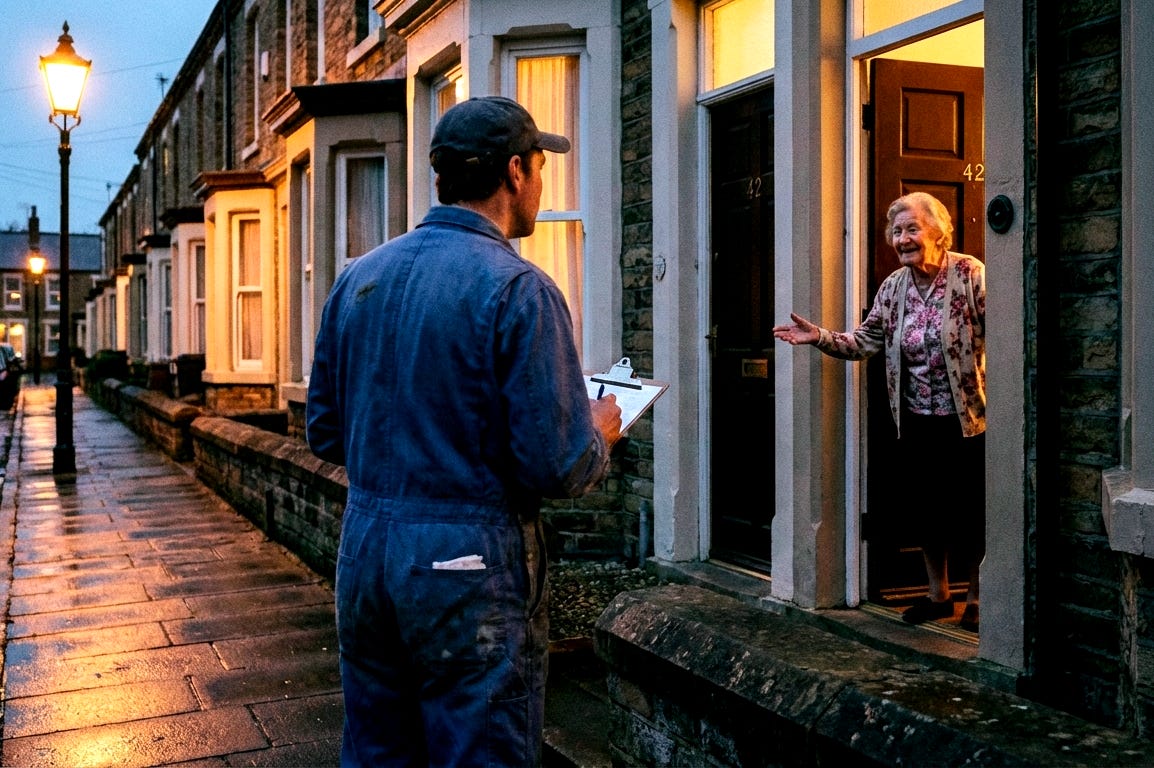
“Good evening,” I’d said, when she opened the door. I had the clipboard. I always have the clipboard: there’s something about a clipboard that short-circuits suspicion. It says system. It says I was expected. “I’m from Westfield Utilities. We’ve had a report of a gas leak on this street and I need to check the meter reading. Shouldn’t take more than a minute.”
She’d looked at the clipboard. Looked at me. Smiled.
“Oh, come in, love. I’ll put the kettle on.”
Just like that. No hesitation. No “can I see your ID?” No “let me call the company first.” Just an open door and an invitation and the warmth of a house that had been waiting all evening for someone to walk into it.
I stepped across the threshold and felt the usual nothing. Some of the ancient ones talk about it like it’s a physical sensation, a lock clicking open, a barrier dissolving. It isn’t. It’s just permission. The body recognises it and lets you through. Without it, you stop. Not painfully. You just can’t. Like trying to walk through a wall, except the wall is invisible and the reason is biological and deeply, profoundly stupid.
I hate the threshold rule. I have opinions about it. This isn’t the place.
The kettle went on. Mrs. Hargreaves bustled around the kitchen with the easy confidence of someone in total command of their domain, and I sat at her kitchen table and accepted a cup of tea I couldn’t drink and tried to find a way to be alone.
“Before I check the meter,” I said, “is there anything else I can help with while I’m here? Sometimes the older properties have issues with…”
“Oh, actually,” she said, and her face did the thing. The grateful, slightly embarrassed thing that said I don’t want to be a bother but. “There is the tap. It’s been dripping for weeks and I just can’t manage it myself anymore.”
So I fixed the tap.
It took twelve minutes. The washer was shot. A simple job, if you know what you’re doing, which I do because I spent three months working at a hardware store in 2019 to build up a cover history on LinkedIn. I lay on my back on her kitchen floor with my head under the sink and listened to her talk about her late husband and her daughter in Bristol and the pigeons that kept coming to her bird feeder, and I thought about the basement and how soon I could get down there.
“You’re a lifesaver,” she said, when I emerged. “Truly. Can I get you anything else? Another tea?”
“I should really check that meter,” I said.
“Of course, of course. It’s just through there, isn’t it? Or… actually, while you’re here, there’s a box in the spare room that’s been bothering me. Too heavy for me to move on my own. Would you mind?”
I moved the box. It was heavy, at least, it would be heavy for a normy. It was a box full of old books. I carried it from one side of the spare room to the other and she thanked me with that same grateful smile and I checked my watch thinking: soon.
The scent hit me in the hallway.
Not strong. Not obvious. More like a flavour I’d read about but never tasted. A word in a language I didn’t speak, suddenly half-recognisable. Something underneath the normal smells of the house: old carpet, lavender, the faint must of a place where the windows didn’t get opened often enough. Something else. Something that made the back of my neck feel warm.
I didn’t know what it was. I want to be clear about that. I’ve never tasted blood. Never wanted to, as far as I know. I was turned in 2003 and the hemoshakes were available almost immediately. Perfectly adequate. I’ve never felt deprived. I’ve never felt the lack of something I couldn’t name.
Until that hallway. And even then, I didn’t name it. I just noticed it, the way you might notice a sound you can’t quite place. Filed it away. Kept moving.
“Oh, one more thing,” said Mrs. Hargreaves.
She wanted me to look at something in the basement.
Of course she did.
I followed her down the stairs. The scent got stronger with every step — not overpowering, but present, layered, like something that had been building up over years. My skin prickled. My mouth felt dry in a way it hadn’t in decades. I told myself it was the air down there: old houses, damp foundations, all sorts of things could cause a reaction.
The door at the bottom was heavy. Steel-core, painted to look like wood. She produced a key from her cardigan pocket and unlocked it with practised ease.
“Just in here, love,” she said. “There’s a shelf that’s come loose off the wall.”
The door opened and the scent hit me.
I stopped on the threshold, not because of the rule this time, but because my body did something I didn’t expect. Something lurched, deep in my chest, and for a moment I couldn’t breathe. Not because I needed to breathe. Because something ancient and dormant had just woken up and was paying very close attention.
The room was lit by a single bare bulb. Concrete floor, whitewashed walls, a workbench along one side. The workbench had tools on it. Neat, organised, well maintained. The kind of tools you’d find in any workshop. Except the layout was wrong. The layout was designed for a specific purpose and once you saw it you couldn’t unsee it.
I saw it.
I’m a predator. Reformed, yes. Domesticated, mostly. But the instincts don’t disappear just because you’ve switched to synthetic. I know what a killing space looks like. I know it the way a chef knows a kitchen: the logic of the arrangement, the flow, the way each tool relates to the next.
Margaret Hargreaves had a killing space in her basement.
I turned to look at her.
She was smiling. Not the grateful smile from upstairs. A different one. Smaller. Patient. The smile of someone who had done this many times before and knew exactly how it ended.
She swung the cricket bat before I finished turning.
It connected with the side of my head with a solid, practised crack. She put her whole body into it — shoulders, hips, everything. The technique of someone who had done this dozens of times. Maybe more.
I barely felt it. A dull thud. A slight pressure. Like being tapped on the shoulder by someone slightly too enthusiastic.
I looked at her.
Her smile didn’t falter immediately. It took a second, a beat in which she processed what had just happened and what it meant. The pipe was still in her hand. She was breathing hard from the swing. And the man she’d just hit with everything she had was standing in front of her, completely unharmed, looking at her with an expression that said I know what you are now.
“That,” I said, “was rude.”
It didn’t take long after that. She was strong for her age but I’m not. Not human, I mean. The bat clattered out of her hand. I had her tied to the workbench chair with electrical cable from her own workshop in under a minute. She didn’t scream. I’ll give her that. She just watched me with those sharp, calculating eyes, recalculating. Trying to work out what had gone wrong.
I took my time with the room. Found the safe, built into the wall behind a shelf unit, combination lock, nothing I couldn’t handle. Inside: cash, jewellery, a few phones. Years of accumulated trophies. Decent haul, all things considered.
I stuffed it into my jacket, turned back to her, and crouched down.
“Here’s the thing,” I said. “You’re going to want to tell someone about me. Eventually. You’re going to want to explain what happened tonight.”
She said nothing. But her eyes moved, just slightly, to the door. Calculating distances. Escape routes. Future plans.
“The problem,” I said, “is that you can’t. Because the moment you start talking about what I am, you have to explain why I was in your basement. And the moment you explain why I was in your basement, you have to explain what’s in your basement. And then it’s over.”
I let that sit for a moment.
Then I stood up, and I showed her.
I don’t know exactly what it looks like from the outside. I’ve never seen it myself. But I know it’s enough. The eyes, maybe. The way I hold myself when I stop pretending. Something shifts — something that says this is what you invited into your house — and every human who’s ever seen it has understood immediately and completely. Or maybe it was the teeth.
Margaret Hargreaves understood.
She didn’t scream then either. She just closed her eyes, very slowly, and when she opened them again there was something new in them. Not fear, exactly. Something quieter. The look of someone who had just been outclassed, and knew it, and was already working out what came next.
Nothing came next. Not for her. Not tonight.
I left the way I came in. Through the front door, into the cold, into the dark. The street was empty. It always was, at this hour.
That’s the story as I tell it at The Undercroft, which is what we call the bar on Canal Street where people like me go to drink things that aren’t on the menu and not think about the sun.
I was halfway through my second telling, the one where I’d started embellishing slightly, adding a line about the tap washer that got a laugh, when Dex leaned forward and asked the question.
“The scent,” he said. “The blood. What was it like?”
The table went quiet. Not uncomfortable. Just... attentive.
I thought about it. About the hallway, and the warmth at the back of my neck, and the way something had shifted in my chest when that basement door opened. About how, for just a moment, standing in that room with the blood of a dozen strangers soaked into the concrete, I had felt more awake than I had in years.
“Nice,” I said.
Someone refilled my glass. The conversation moved on.
Outside, somewhere, the sun was coming up. None of us mentioned it.
"I hate the threshold rule. I have opinions about it. This isn't the place." I'd read an entire novel narrated by this voice. The restraint at the end seals it. Strong piece.
Nice! I like how we're given just enough information to keep us wanting to know what will happen next. Well done!